Content ID for AI Music: The Claim You Can't File (2026)
Content ID requires "exclusive rights to the material that's evaluated" — and a wholly AI-generated track has no copyright to hold exclusively. The consequence chain, the protection ladder that's still open, and the strategy that needs no enforcement at all.
Contents7 sections
Content ID is the machine that makes recorded music pay on YouTube: fingerprint the catalogue, claim every matching upload platform-wide, route the ad revenue home. And for a wholly AI-generated track, it is structurally closed — not because of an AI policy, but because of one sentence in the eligibility rules: "Copyright owners must have the exclusive rights to the material that's evaluated." A track with no copyright has no exclusive rights to hold. This article walks the consequence chain and the protection ladder that's still open.
If you want the money side first — what an unprotected AI music video actually earns from ads versus every other route — start with our pillar on Suno monetization for video-first artists. Everything below was checked against YouTube's help pages in August 2026.
What Content ID Actually Does
When a rights holder is admitted, their audio is fingerprinted into YouTube's reference database. Every new upload is scanned; matches get claimed automatically. The claimant chooses the outcome per match: monetise it (the re-uploader's ad revenue routes to the claimant), track it, or block it. At label scale this runs across millions of uploads with no human touching anything — which is why a viral song earns its owner money even from lyric videos, sped-up edits, and re-uploads the owner has never seen.
That's the machinery an independent artist wants when a track takes off. Whether you can have it comes down to eligibility.
The Bar a Wholly AI Track Can't Clear
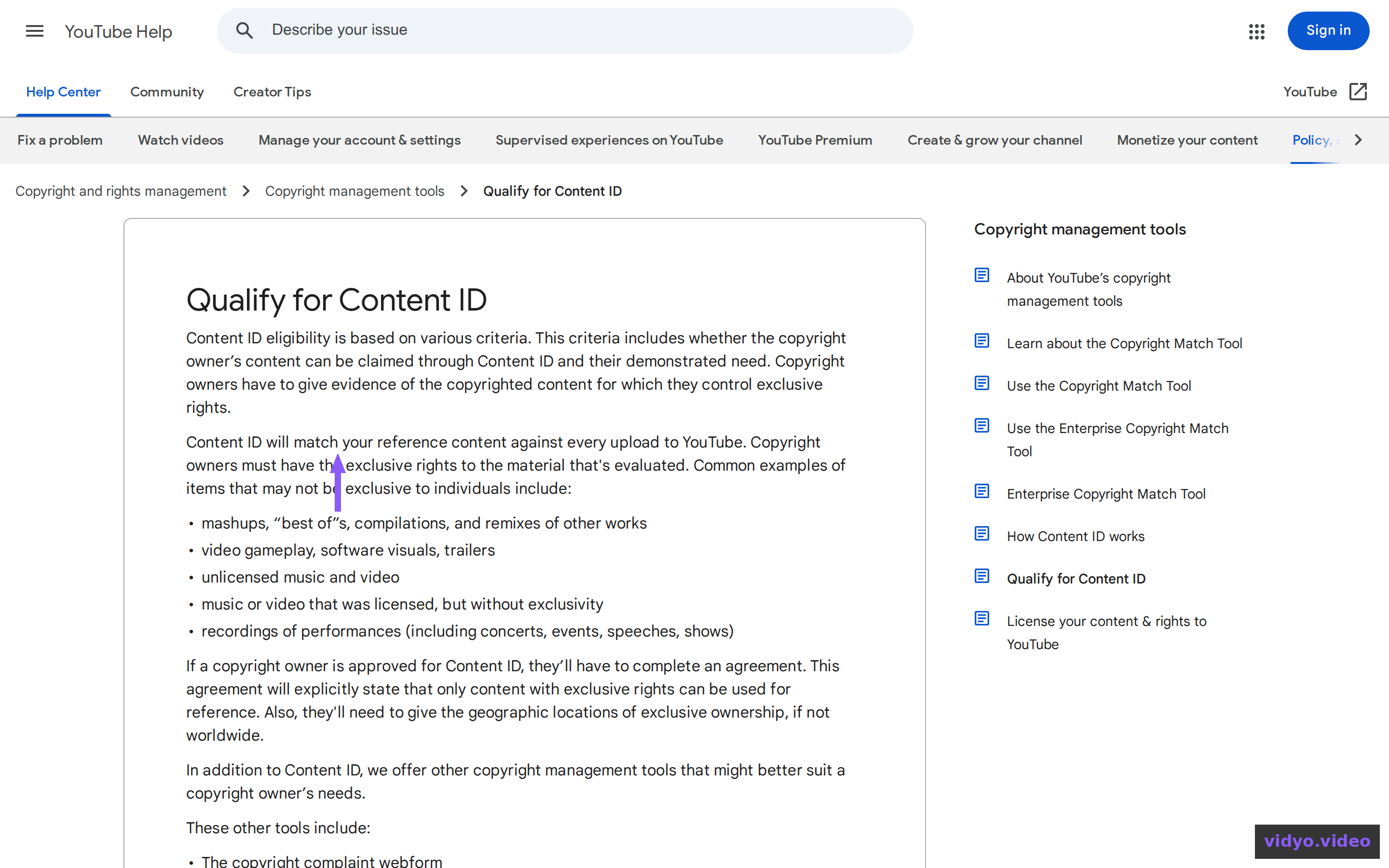
YouTube's qualification page sets two requirements: applicants must have "the exclusive rights to the material that's evaluated" and must "give evidence of the copyrighted content" they control. Both assume a copyright exists. For wholly AI-generated music in the US, none does — the Copyright Office's January 2025 report and the Supreme Court's March 2026 refusal to revisit Thaler v. Perlmutter made the settled human-authorship rule exactly that: settled. Suno's own terms tell you the same thing — the company "makes no representation or warranty that any copyright will vest in any Output."
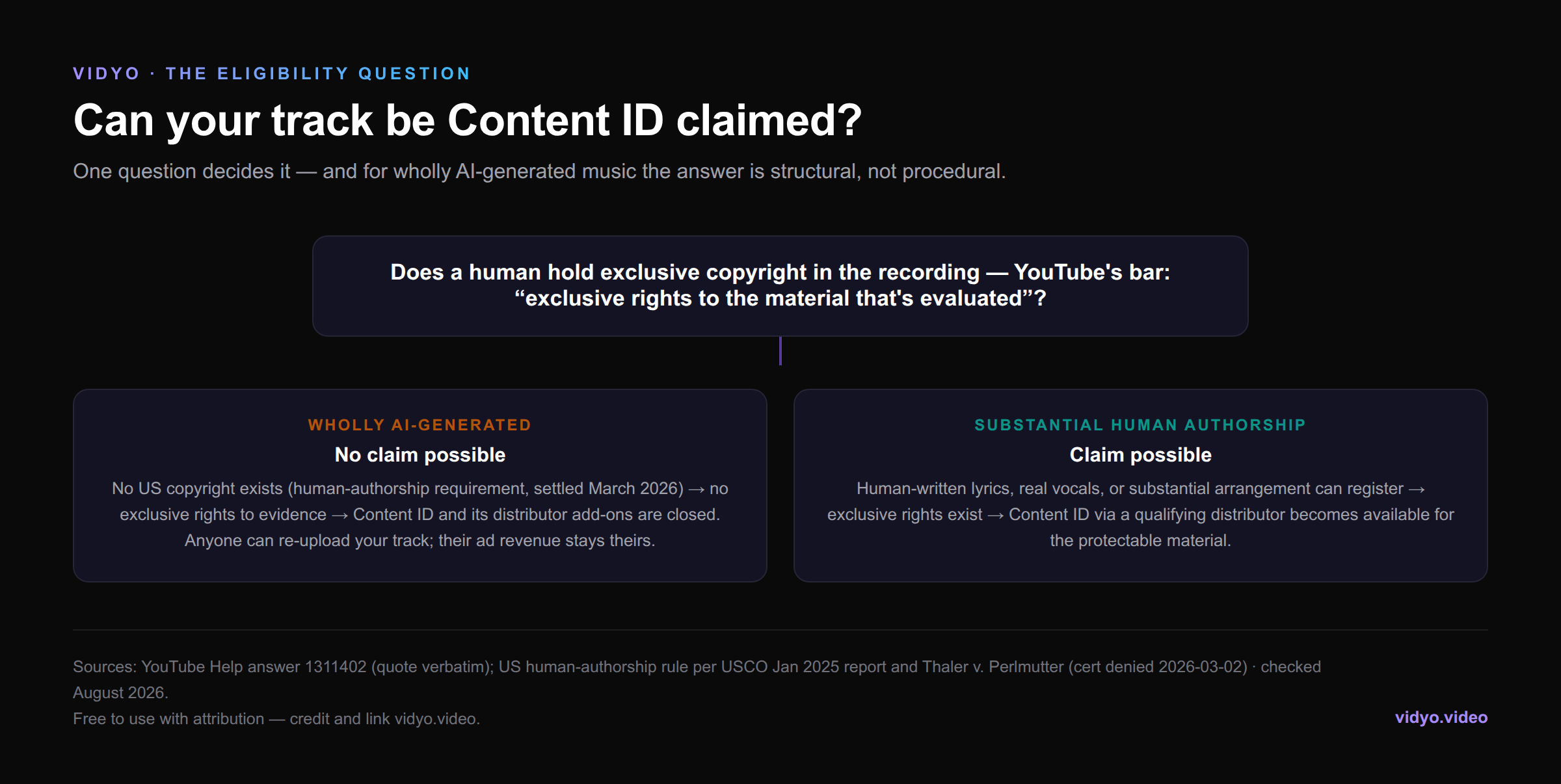
Three follow-on facts close the loopholes people reach for. Distributor Content ID add-ons apply the same exclusivity test, so routing the track through a distributor doesn't manufacture a right that doesn't exist. The ineligible-content list already excludes non-exclusive material outright. And an assignment from Suno — real and useful for selling — can't assign a copyright that never came into existence.
So What Happens When Your Track Gets Re-Uploaded?
Concretely: a hundred channels re-upload your song, and their ad revenue stays theirs. You cannot claim it, monetise it, or automatically block it. At the music-channel RPMs our pillar documents ($1–$3 per 1,000 views), the re-uploaders aren't getting rich either — but the asymmetry stings at scale, and it's the quiet reason ad revenue ranks dead last among AI-music income routes: the one enforcement tool that makes per-view income defensible is the one you can't have.
The Protection Ladder That's Still Open
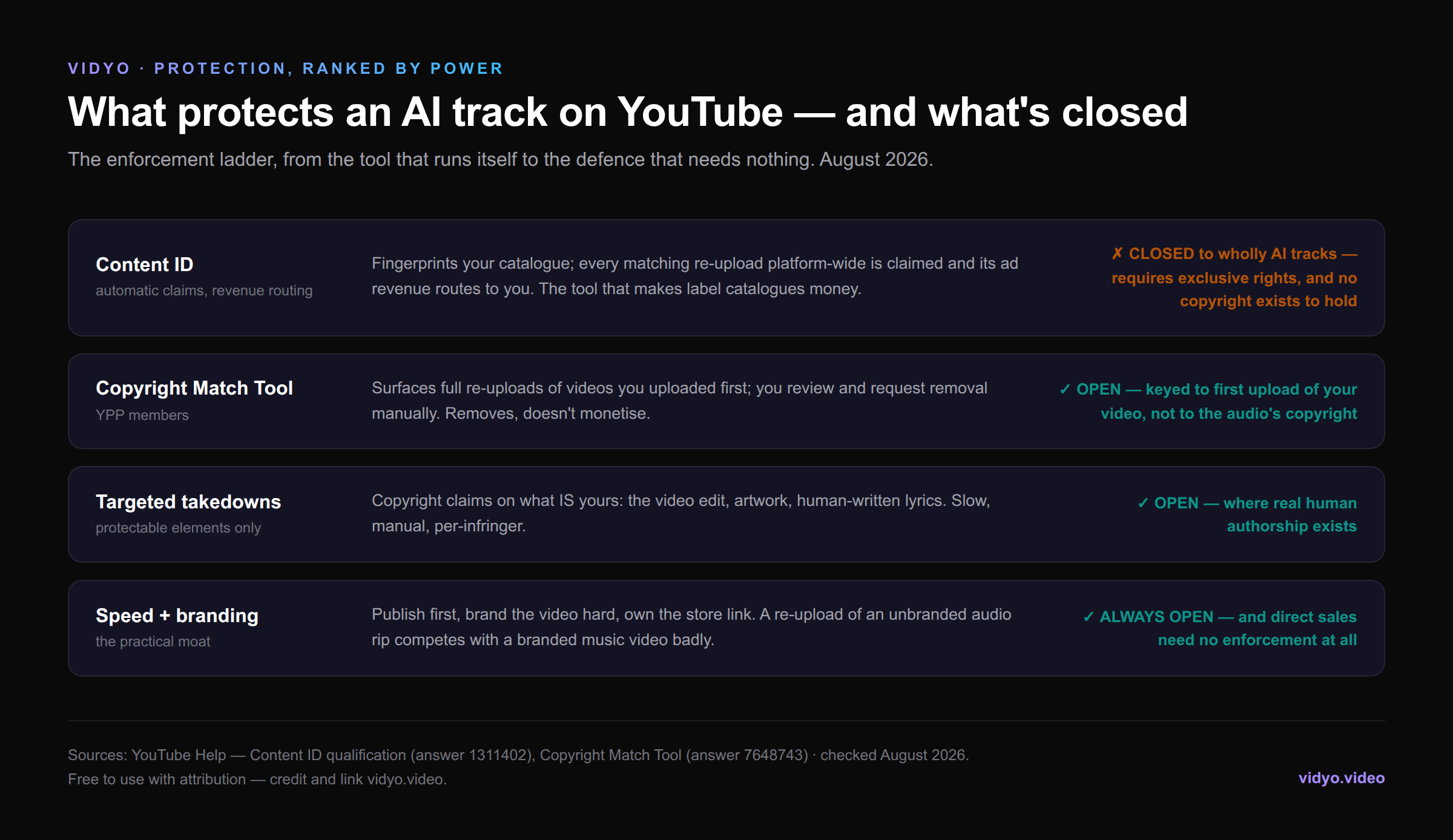
The Copyright Match Tool is the biggest still-open door. Available to Partner Program members, it surfaces re-uploads of videos you uploaded first — it keys on your upload's priority, not on registered copyright. You review matches and can request removal. Its limits: it removes rather than monetises, it catches full re-uploads of your video (not your audio under someone else's visuals), and you must be first — one more reason to publish your own video the day the track is done.
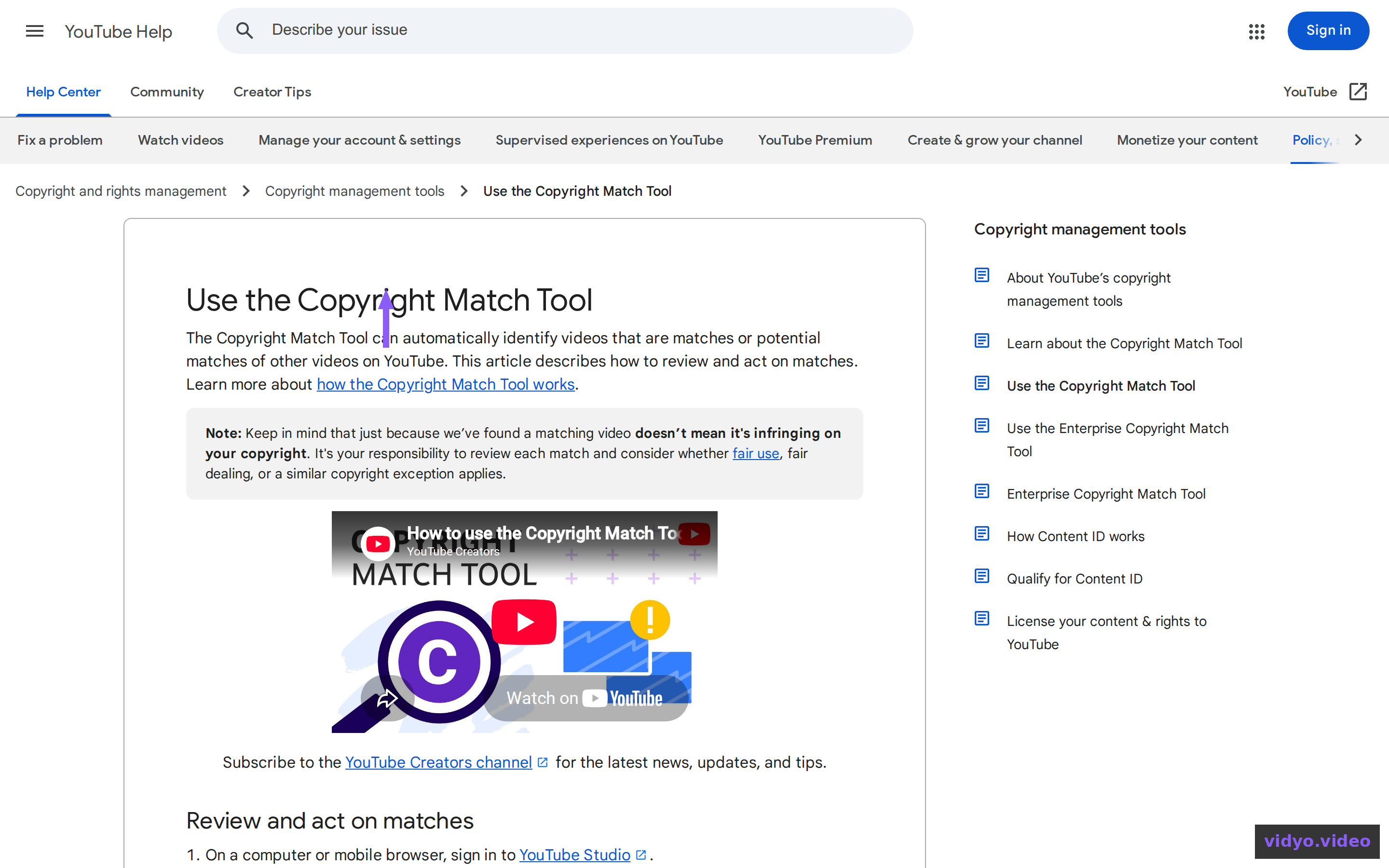
Targeted takedowns work where you hold something genuinely protectable: the video edit, the artwork, human-written lyrics. Manual and per-infringer, but real. And hybrid authorship changes the game entirely — add your own vocals, lyrics, or substantial arrangement and a registrable work exists, reopening both registration and distributor Content ID for the protectable material. That's the strategic reason serious AI-first artists drift toward hybrid workflows as they grow.
The Composition Side: PROs Follow the Same Line
Content ID governs the recording on YouTube, but songs earn on a second layer — performance royalties on the underlying composition, collected by PROs like ASCAP and BMI. Same story there: the PROs follow the Copyright Office's human-authorship line, so a wholly AI-generated composition can't register for the performance royalties that human songwriters collect when their work is streamed, broadcast, or played live. It's worth internalising how consistent the whole system is: every automated, passive, rights-based revenue stream — Content ID claims, PRO distributions, mechanical royalties on covers of your song — keys off a registrable copyright. Wholly AI work sits outside all of them at once, which is why the active routes (selling, sync, commissions) aren't just alternatives; for fully-generated tracks they're the entire menu.
Sync deserves one clarification here, because people assume no copyright kills it too. It doesn't. A sync placement is a commercial agreement about usage — the buyer needs a licence from whoever controls the master, clean provenance, and indemnities, all of which a paid-plan Suno assignment supports. Buyers on brief boards price that in; what they won't accept is murky provenance or an undisclosed soundalike of a real artist.
The Hybrid Path: If You Want Claimability, Earn It
If Content ID genuinely matters to your plan — you're building a catalogue you expect to be re-uploaded at scale — the path is adding real human authorship, and it has an order of effectiveness:
- Write the lyrics yourself. Human-written lyrics are the cleanest registrable element and the easiest to document — keep drafts with timestamps.
- Record real vocals. A human vocal performance over AI instrumentation creates protectable authorship in the recording itself, not just the words.
- Make substantial arrangement decisions. Re-structuring, re-instrumenting, and editing generated stems can support registration — the Copyright Office's line is that prompts alone don't, but meaningful creative control over the result can.
- Document everything, then register. Registration is what turns "I have rights" into "I can evidence exclusive rights" — the exact phrase the Content ID application asks for.
Be honest with yourself about the trade: the hybrid path costs the speed that made AI generation attractive. For most video-first artists, the better answer is the one below.
The Strategy That Needs No Enforcement
Step back and the practical answer isn't legal at all. Enforcement protects per-view income; income that doesn't depend on views doesn't need protecting. A re-uploader can copy your audio, but they can't copy your storefront, your fan list, or your sync relationships — a store you control beats a claim you can't file. Publish your branded video first (which also arms the Copyright Match Tool), disclose it properly — the disclosure walkthrough takes a minute — and point the description at the store. The track that can't be defended per-view can still be the engine of income nobody can intercept.
Eddie Mathews is the music & AI tools editor at Vidyo. Sources: YouTube Help answers 1311402 and 7648743 (quotes verbatim), Suno Terms of Service (rev. March 26, 2026), USCO January 2025 report — checked August 2026.