Suno's New Download Limits: Export Before September 3, 2026
From September 3, 2026 Suno meters downloads: 7 lifetime on Free, 20/month on Pro, 60/month on Premier — applied retroactively to every song in your library. Until the deadline there's no cap at all. Here's the fine print most coverage missed, and how to get your catalogue out in one pass.
Contents12 sections
- The exact limits, by tier
- The retroactive clause everyone missed
- Two problems, one toolkit
- The counting rules are better than you think
- The pricing math: what Suno actually built
- What happened to the free tier
- Who this actually hurts
- Why Suno did it
- What you are not losing
- What to do before September 3
- The step most people skip: after the export
- The honest summary
On September 3, 2026, Suno stops being a service you can freely export from and becomes a service with a metered download counter: 7 downloads for the lifetime of a free account, 20 a month on Pro, 60 a month on Premier. And the clause most coverage skipped is the one that matters — the limits apply to every song in your library, including everything you made before the deadline. Nothing is grandfathered.
That last part turns a policy announcement into a deadline. If you have hundreds of tracks sitting in Suno that you never got around to exporting, the window for pulling them down without a counter running is now measured in days — because until September 3 there is no cap at all, and exporting your entire back catalogue right now uses no quota and breaks no rule.
But the counter is really only the first of two walls between your Suno tracks and money. The second — distributor AI screening, which silently kills flagged tracks at upload — doesn't expire on September 3; it applies to every submission, forever. This article covers both: the exact limits and fine print of the new policy, the pricing arithmetic that reveals what Suno actually built, and the one toolkit we've tested — Undetectr — that solves the export problem and the screening problem in a single $39 Lifetime plan.
The Exact Limits, by Tier
These come from Suno's own announcement and its published FAQ, not secondhand reporting.
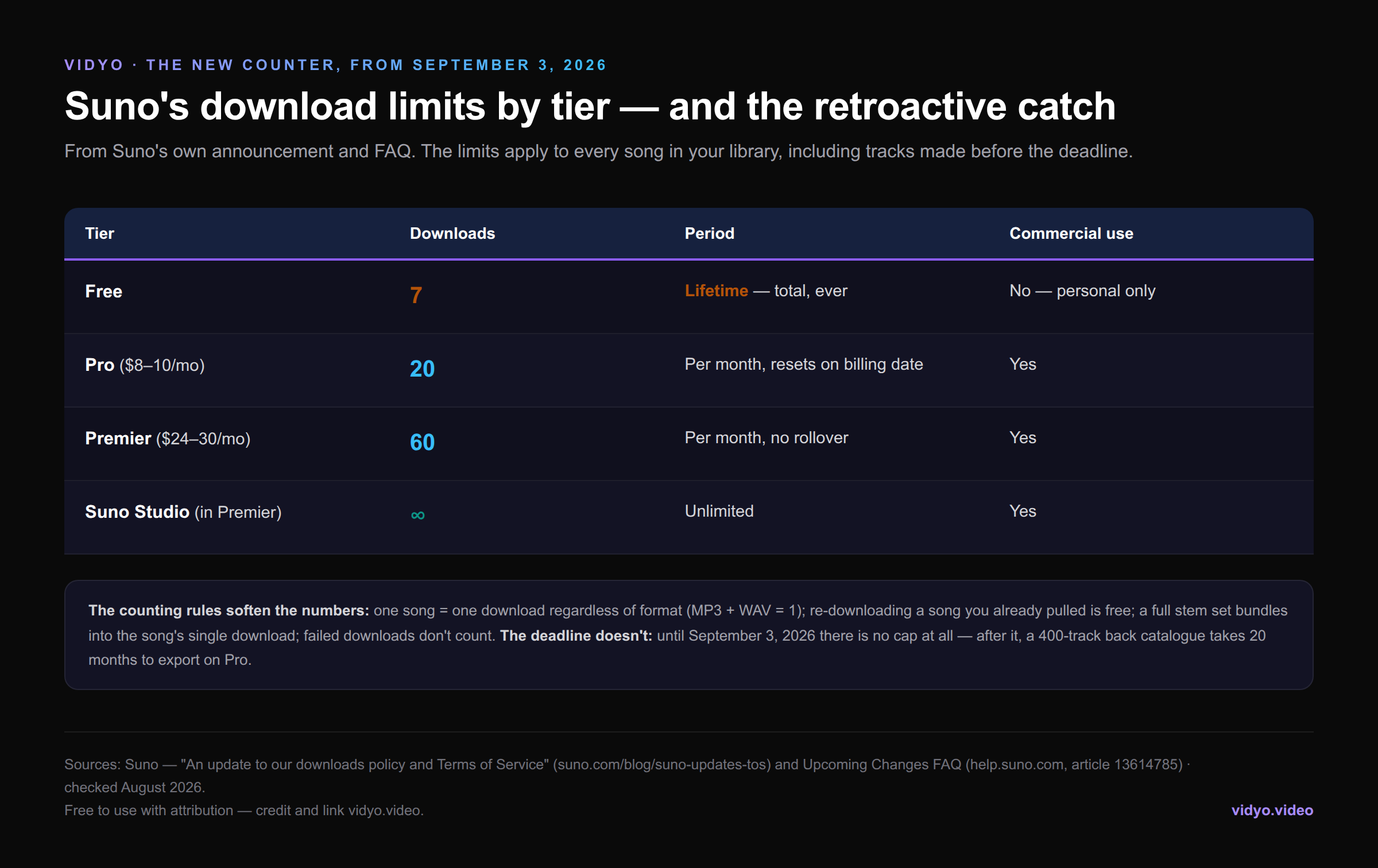
Monthly allowances reset on your billing date, not the first of the month, and unused downloads don't roll over. Extra downloads beyond the allowance can be purchased. On pricing: the figures reported alongside the announcement were $8/month for Pro and $24/month for Premier, with Suno's standard monthly list prices historically at $10 and $30 — the arithmetic below holds on either basis, which turns out to be the interesting part.
The Retroactive Clause Everyone Missed
Suno's FAQ states the limits apply to all songs, "including songs created before that date." Almost every article reported the numbers and stopped there — but a cap on future generation is a mild inconvenience, while a cap on everything you've ever made is a completely different proposition, and the second one is what was announced.
Work it through for a real library. A moderately active user with 400 songs:
- On Free, they may export 7 of them. Ever. Not commercially.
- On Pro at 20 a month, exporting the catalogue takes 20 months.
- On Premier at 60 a month, just under 7 months.
- Before September 3, it takes an afternoon — there is no counter running.
That's the urgency of this article in four lines. The policy has sound reasoning behind it, as we'll get to — but it converts an unlimited archive into a metered one, retroactively, with weeks of notice.
Two Problems, One Toolkit
Before the fine print, it's worth seeing the whole board — because getting your music out of Suno and getting it earning are two different problems, and panicking about the first while ignoring the second is how exported catalogues end up as dead files on a hard drive.
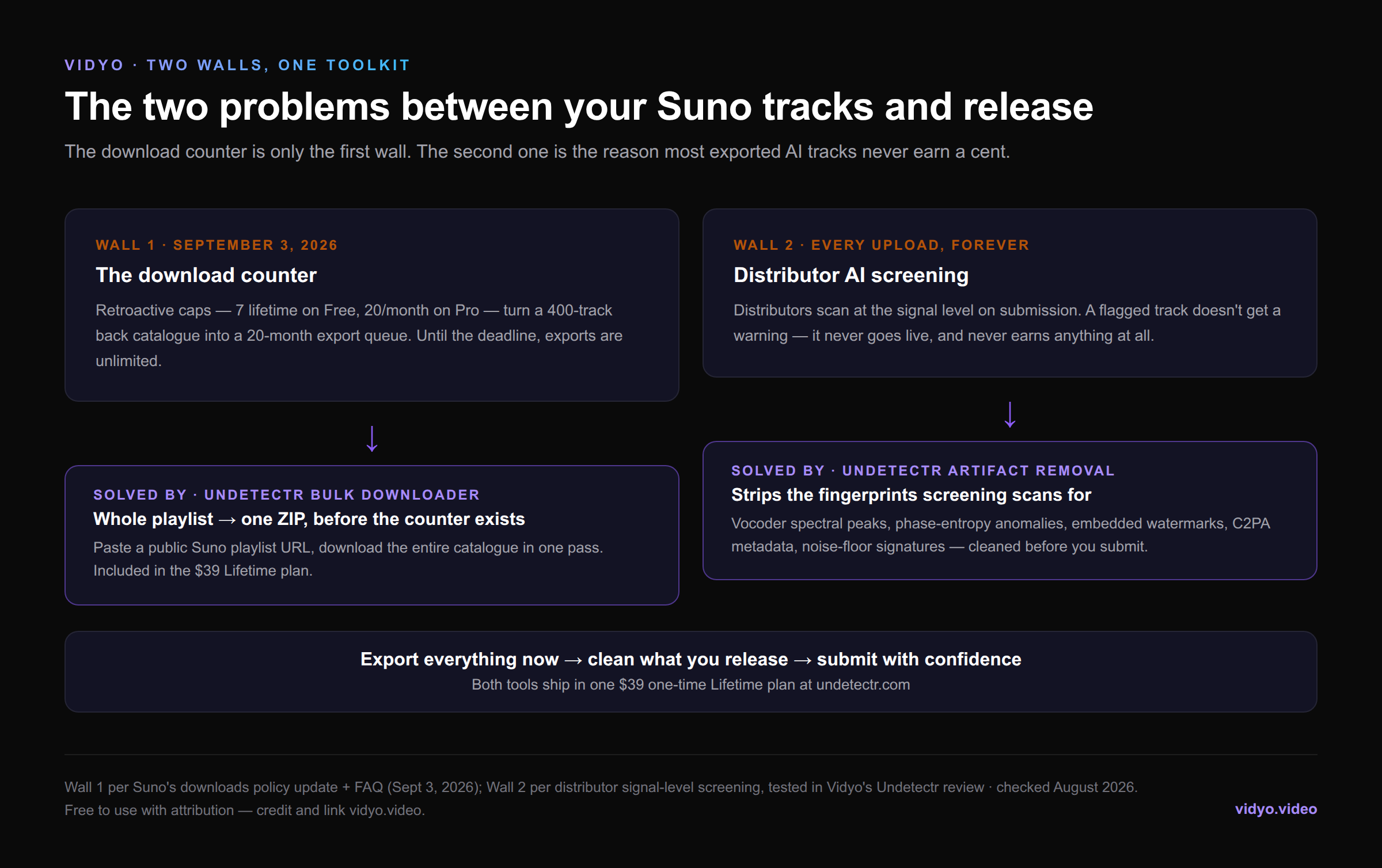
Wall 1 is the download counter, and it has a hard deadline. Undetectr's bulk downloader clears it in one pass — a public playlist URL in, your whole catalogue out as a ZIP — while exports are still uncapped. Wall 2 is distributor AI screening, and it has no deadline at all: every track you submit, forever, gets scanned at the signal level, and a flagged track never goes live. Undetectr's artifact removal is built for exactly that layer — the same $39 Lifetime plan covers both tools, which is why it's the one purchase that addresses this entire article. We tested the toolkit end-to-end in our Undetectr review and rated it 4.75/5.
The Counting Rules Are Better Than You Think
Almost nobody reported the fine print, and it materially changes how bad this is. Straight from Suno's FAQ:
- One song counts as one download, regardless of format. Pulling both the MP3 and the WAV of a track is one download, not two.
- Re-downloading is free. Once a song is on your counter, pulling it again later costs nothing. Lost a file? Re-download at no cost.
- All stems bundle into the song's single download. This is the big one — a full stem set (vocals, drums, bass, instruments) doesn't multiply against your quota. For anyone doing real DAW work, this removes what would otherwise be a crippling restriction.
- Failed or interrupted downloads don't count. A dropped connection doesn't cost a slot.
Read together, these rules show what Suno is actually metering: distinct songs leaving the platform — not files, formats, or operations. It's a carefully designed policy aimed at catalogue volume, not at people working on individual tracks. Twenty distinct finished songs a month is a serious release schedule; twenty files would have been absurd, and Suno chose the sane one.
The Pricing Math: What Suno Actually Built
Divide subscription price by download allowance and something falls out that Suno didn't advertise: the unit cost is identical across both paid tiers. Pro: $8/mo ÷ 20 = $0.40 a song. Premier: $24/mo ÷ 60 = $0.40 a song. On monthly list pricing it's $0.50 on both. That is not how subscription tiers normally work — higher tiers almost always carry a volume discount — and Suno deliberately declined to give one.
What that reveals is a change in what the product is. Suno historically sold generation capacity, metered in credits. From September 3 it also sells export capacity, at a flat rate of roughly 40–50 cents a song. A flat unit price is exactly what you design when the goal is making volume expensive in proportion to volume: under the old model a streaming-farm operator paid $30 and exported unlimited tracks, so per-track cost fell toward zero as they scaled; under the new one it's pinned at 40 cents forever. Against the fractions of a cent a fraudulent stream earns, that arithmetic stops working — which is precisely the point. The side effect is that legitimate high-volume producers pay the same 40 cents, with Suno Studio (unlimited, included in Premier) as the sanctioned escape hatch.
What Happened to the Free Tier
The free-tier change is the most severe and least discussed. Seven downloads for the lifetime of the account, personal and non-commercial only. Not seven per month — seven, ever. With Suno reporting over 100 million users against roughly 2 million paid subscribers, the free tier has been the top of a very wide funnel; what it is now is a demo. If you're on Free with tracks you care about, yours is the most urgent position in this article: after September 3 you get seven exports total and no commercial rights regardless. Before it, you can still pull everything.
Who This Actually Hurts
- Streaming-farm operators — hit hardest, entirely by design. Generating thousands of tracks and botting the streams no longer pencils out at a flat 40 cents per export. This is the stated target, and a legitimate one.
- Catalogue builders — hit hard as collateral. Stock, production-music, and long-tail streaming libraries now face a ceiling of 720 exports a year on the top consumer tier. Real business, no wrongdoing, materially constrained by a rule aimed at someone else.
- Free-tier users with a back catalogue — hit hardest in relative terms: seven lifetime downloads against a library of hundreds.
- Working producers releasing finished tracks — barely affected, and worth saying clearly given the breadth of the panic. Two to five finished songs a month against a 20-download allowance, with stems bundled and re-downloads free, is comfortable.
- Hobbyists who never download — unaffected. Playback and sharing stay unlimited on every plan.
Why Suno Did It
The stated reason is to "make it harder for bad actors to mass-export music" and keep the platform for "intentional music creation." Unusually for a corporate justification, the numbers back it up. Deezer receives around 90,000 fully AI-generated tracks per day — over half its daily uploads, up ninefold in eighteen months — and reports that up to 70% of streams on those tracks are fraudulent. Spotify removed more than 75 million spam-like tracks in twelve months. Yet fully AI-generated music is only 1–3% of actual listening on Deezer: the flood is enormous at upload and nearly invisible at playback, because the problem isn't listeners being swamped — it's royalty pools being diluted by tracks nobody plays, uploaded purely to farm payouts from a pool that grew from $1 billion in 2014 to $10 billion in 2024 on Spotify alone.
The legal half: the announcement came six days after Suno lost GEMA v Suno in the Munich I Regional Court on July 31, 2026, where the court found six well-known works reproducibly contained in Suno's v3.5 and v4 models, with penalties up to €250,000 per future breach. Universal and Sony actions are ongoing. Capping exports is the cheapest available lever against the abuse pattern the industry — and the courts — are now squarely focused on.
What You Are Not Losing
The reaction has been disproportionate in places, so let's be precise. Directly from Suno: nothing is deleted — "everything you've already made will remain in your library." Playback and sharing stay unlimited on every plan, free included. Files you already downloaded remain yours — on a paid plan they "remain yours to use commercially or personally." Covers and remixes of existing songs continue to work, and retired models don't break songs already made. This is a restriction on export, not on access, ownership, or creation — the version circulating in some corners, that Suno is taking people's music away, is not accurate.
What to Do Before September 3
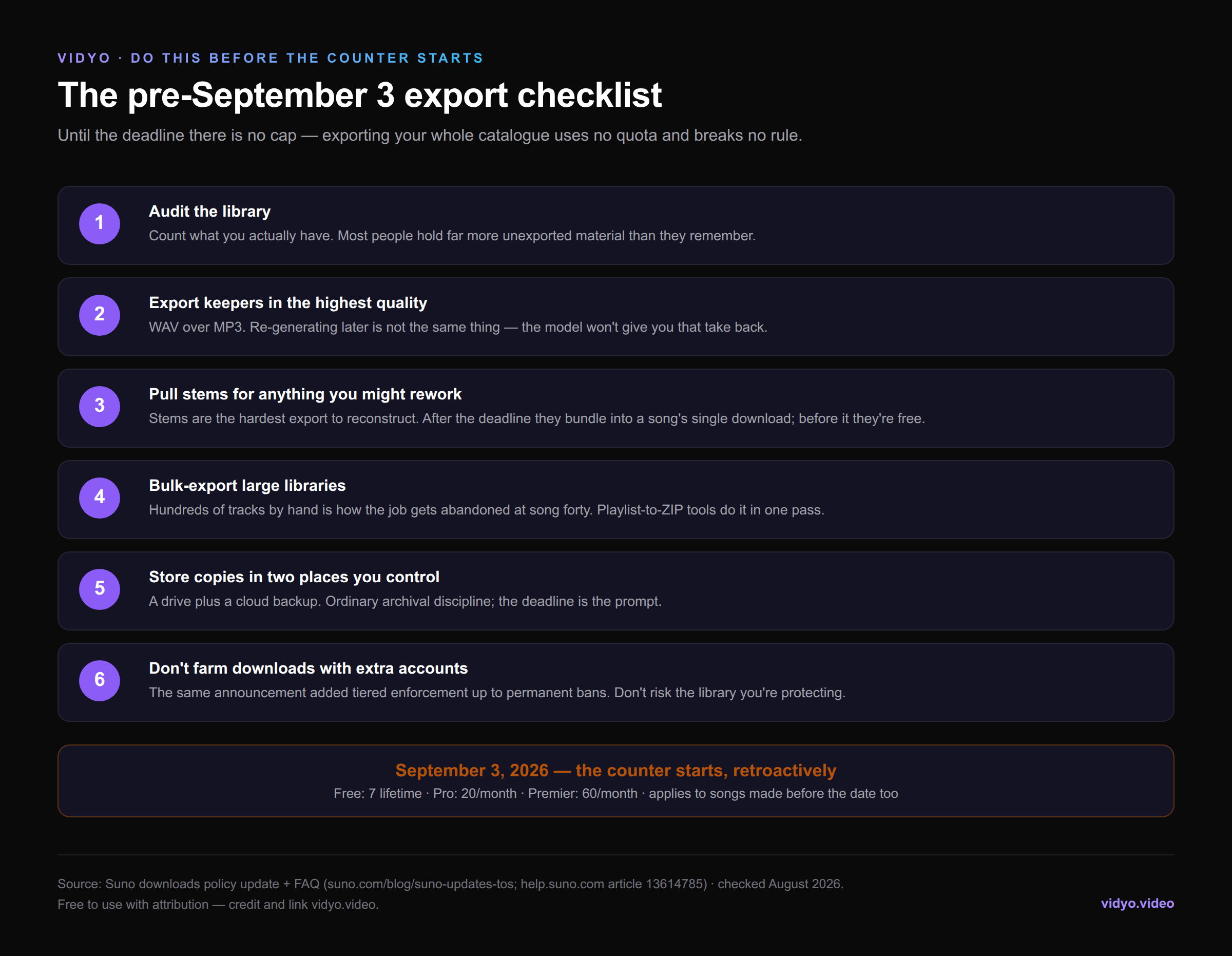
1. Audit what you actually have. Most people hold substantially more unexported material than they remember, spread across abandoned experiments. Some of it is better than you recall.
2. Export the keepers first, in the highest quality available. WAV over MP3. If you later want to master or distribute a track, you want the best source file — re-generating is not the same thing, because the model won't give you that take back.
3. Pull stems for anything you might rework. Stems are the highest-value export because they're the hardest thing to reconstruct later.
4. Bulk-export large libraries rather than clicking through. Several hundred tracks by hand is how this gets abandoned halfway. Undetectr's Lifetime plan includes a bulk downloader that pulls an entire public playlist as one ZIP — gather what you want into a playlist first, then export it in one pass. We rated the wider toolkit 4.75/5 in our full Undetectr review.
5. Store it somewhere you control, in two places. A drive and a cloud backup. Ordinary archival discipline; the deadline is a good prompt to finally do it.
6. Don't create extra accounts to farm downloads. The same announcement introduced tiered enforcement running to permanent bans. Risking the library you're trying to protect, to dodge a limit you can legitimately get ahead of this month, is a bad trade.
The Step Most People Skip: After the Export
Once a track is out of Suno, the constraint that decides whether it ever earns anything is not Suno's counter — it's your distributor's AI screening. That check runs once, at upload, at the signal level, and a flagged track doesn't come back with a warning; it simply never goes live. This is the layer Undetectr is actually built for: removing the fingerprints distributors scan for — vocoder spectral peaks, phase-entropy anomalies, embedded watermarks, C2PA metadata, and noise-floor signatures — so a finished track clears intake. It doesn't change the composition, and it won't fool composition-based checker sites; it cleans the signal layer that automated screening reads. In our testing for the review, processed Suno tracks went from flagged to accepted at distribution.
So the sequence for the next three weeks writes itself: export everything now while it's free (Wall 1), then clean the tracks you actually intend to release (Wall 2) — both steps inside the same toolkit. And once they're live, remember the video side is where discovery happens — our breakdown of what AI music actually earns on YouTube covers why the exported catalogue is worth more as direct sales and sync material than as ad inventory.
The Honest Summary
Suno's download limits are a defensible policy with a genuine problem behind it — 90,000 AI tracks a day at one streaming service, most of their streams fraudulent, 75 million tracks purged by Spotify in a year. The fine print is more reasonable than the headline: one song is one download in any format, re-downloads are free, stems bundle, nothing is deleted, everything stays playable. If you release a handful of finished tracks a month, you'll barely notice.
The genuine problem is the retroactive clause. Applying the cap to a back catalogue built under different rules, with weeks of notice, puts the cost of the fix on people who weren't the target — free-tier users with real libraries come off worst. Which leaves one action, and it expires: until September 3 there is no counter. Export what you care about while that's still true.
Eddie Mathews is the music & AI tools editor at Vidyo. Figures and quotes were checked against Suno's announcement and FAQ, Variety, Billboard, and Digital Music News in August 2026. Vidyo has previously tested and reviewed Undetectr; see the full review for methodology.