Can You Sell Suno AI Music? Commercial Rights vs Copyright
On a paid plan Suno grants commercial use and takes no share of your royalties — and states outright that it cannot grant you copyright. Here's what each tier permits, where copyright law lands on AI-assisted music, and the third gate that stops more releases than either.
Contents9 sections
Yes — you can sell music you made with Suno, provided you made it on a paid plan. Suno grants that outright, takes no cut, and says so in its own help centre. The question that actually trips people up is the one hiding behind it: selling a track and owning a track are two different permissions, granted by two different institutions.
Suno is unusually direct about this. Its documentation states that granting commercial use rights "does not guarantee copyright protection" and that copyright "is determined by your region/country's copyright office, not by Suno." That single sentence resolves most of the confusion in this topic, and almost nobody quotes it.
This article covers what each Suno tier actually permits, where copyright law currently lands on AI-assisted music, and the third gate — the one that stops more releases than the other two combined, and the only one you can fix this afternoon.
What Suno actually grants you
Suno uses the phrase granted commercial use. In its words, songs made on any paid plan are granted commercial use, "allowing you to monetize via distribution, traditional sales, and more," and — the part worth reading twice — "Suno is allowing you to collect 100% of the royalties without claiming a share."
That is a genuinely generous term, and more permissive than a lot of stock-music licensing. Concretely, a paid subscription lets you:
- Download tracks for use outside Suno
- Monetise them however you wish
- Distribute to streaming platforms
- Use them in film, TV or video games
- Sell them independently — an album on Bandcamp, for instance
The critical detail is when the track was made, not when you sell it. Rights attach to songs created while you were subscribed. A track generated on the free tier does not become commercial because you upgraded afterwards.
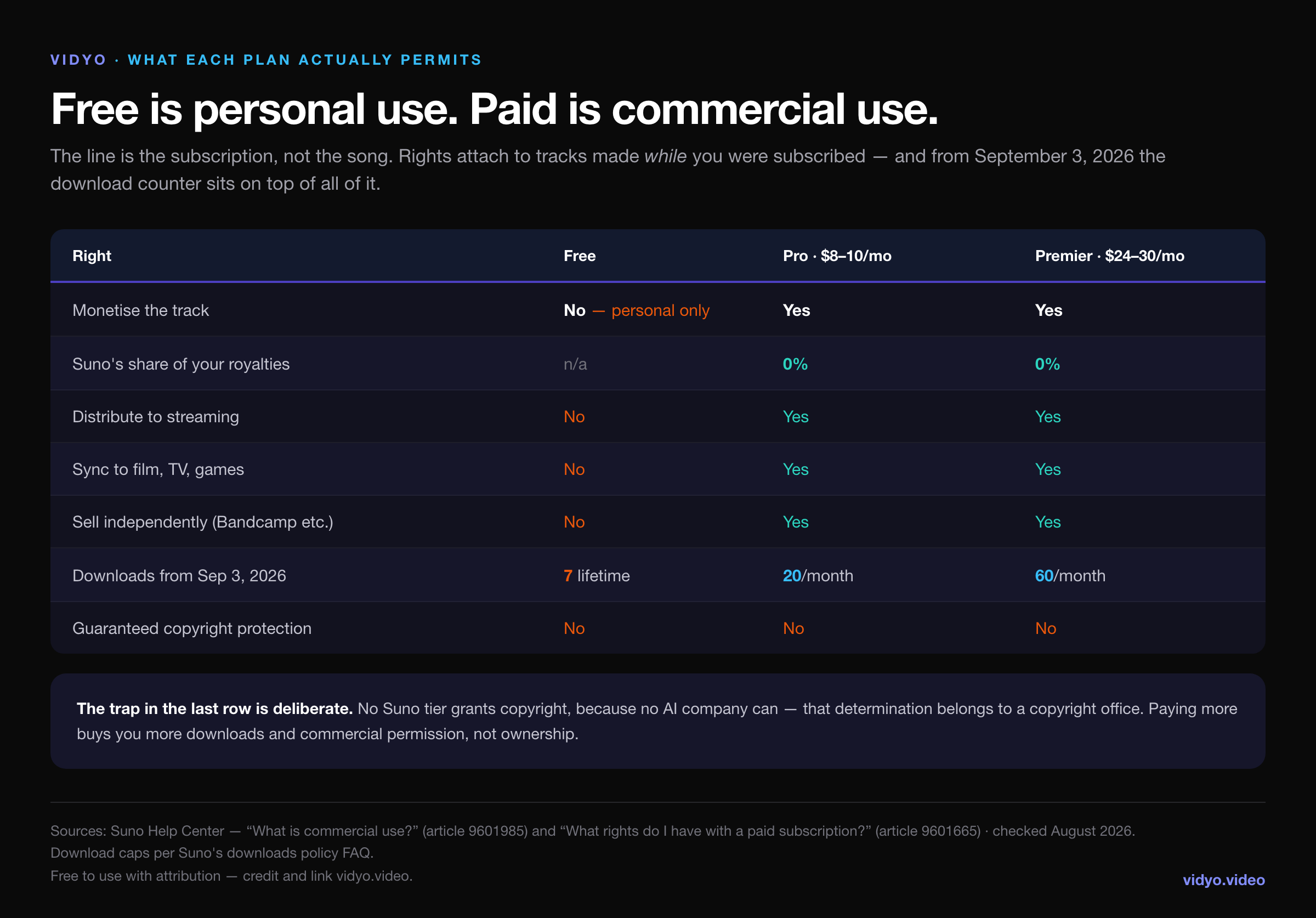
Note the bottom row. It is identical across all three tiers, and it is the subject of the rest of this article.
Permission to sell is not ownership
These two things get collapsed constantly, and they are not the same:
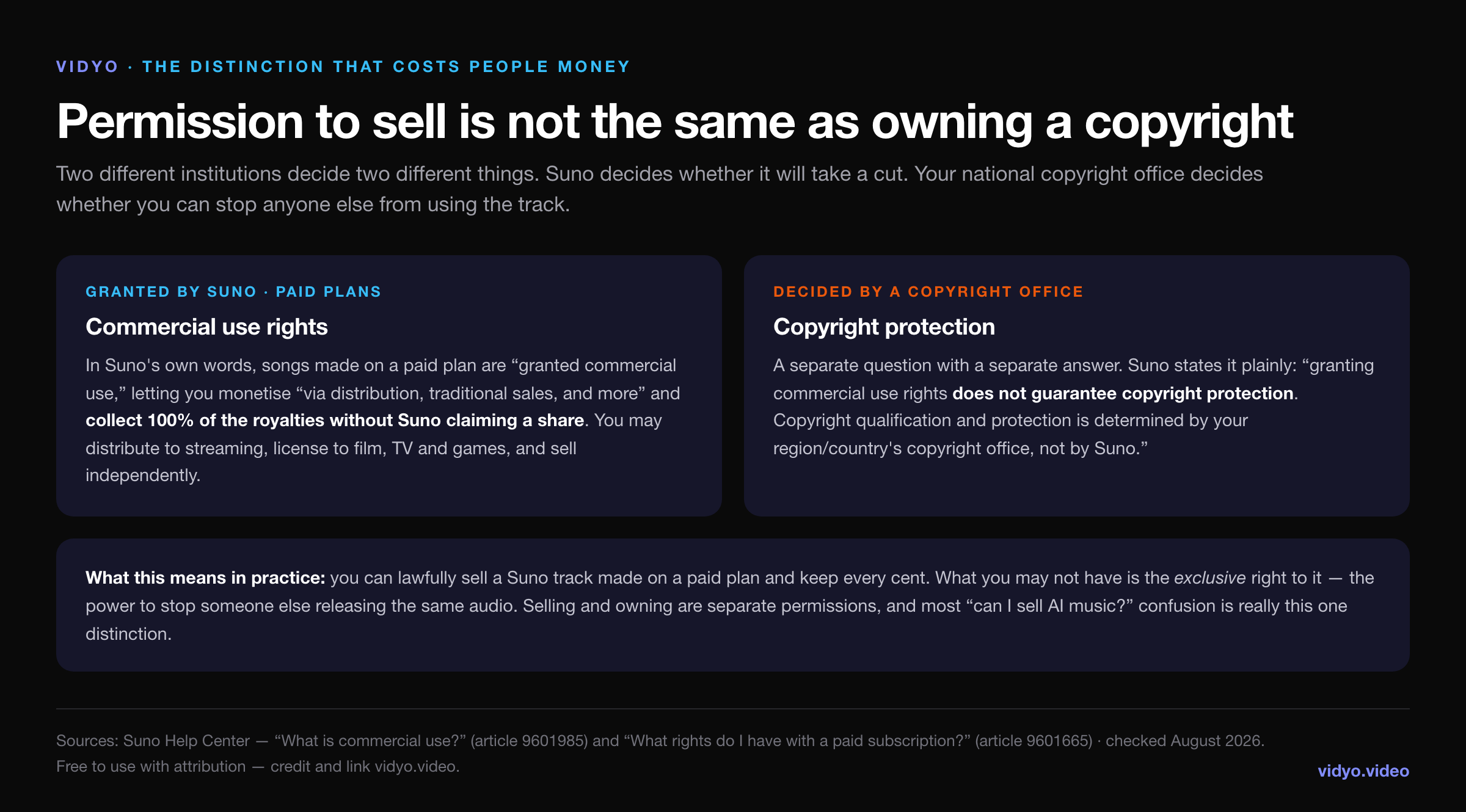
Commercial use is a licence from Suno to you. It answers "am I allowed to earn from this, and does Suno want a share?" The answer on a paid plan is yes, and no, respectively.
Copyright is an exclusive right granted by a government. It answers "can I stop someone else from using this?" Suno cannot grant it, disclaim it, or promise it, because it was never Suno's to give.
In practice this means you can release a Suno track, distribute it, and bank every cent of the royalties — while potentially lacking the standing to stop another person releasing the very same audio. For most artists releasing original songs that is a theoretical risk. If you are licensing a track exclusively to a client, or building a catalogue you intend to defend, it stops being theoretical.
Where copyright law currently stands
In the United States, the Copyright Office addressed this directly in its Copyright and Artificial Intelligence, Part 2: Copyrightability report, published in January 2025. The framework it set out is narrower than the optimists claim and broader than the doomsayers do.
The test is meaningful human authorship. Purely AI-generated output, with no sufficient human control over the expressive elements, is not copyrightable. But work that embodies genuine human creative contribution can be registered — with the AI-generated portions disclaimed. By April 2026 the Office had registered over 6,000 human-AI collaborative works, so this is a live, functioning path rather than a theoretical one.
What that means for a Suno track depends entirely on what you brought to it:
- A prompt alone is weak ground. Typing a genre and a mood and accepting what comes back is the case the Office has been most sceptical of.
- Your own lyrics are strong ground. Lyrics you wrote are human-authored text, protectable in their own right, whatever happens to the audio around them.
- Selection, arrangement and editing count. Structural choices, comping between generations, and post-production shape the expressive result and are exactly what a registration is built on.
- It is assessed case by case. Examiners look at each submission individually. There is no blanket ruling that covers "Suno tracks" as a category.
Two honest caveats. This describes US law; your national office may take a different view, and Suno's own wording defers to "your region/country's copyright office" precisely because the answer varies. And this is general information rather than legal advice — if a catalogue's value depends on the answer, pay a lawyer who specialises in it.
The third gate, and the one that actually bites
Rights and copyright are the two gates people research. There is a third that most artists never learn about until a release quietly fails to appear.
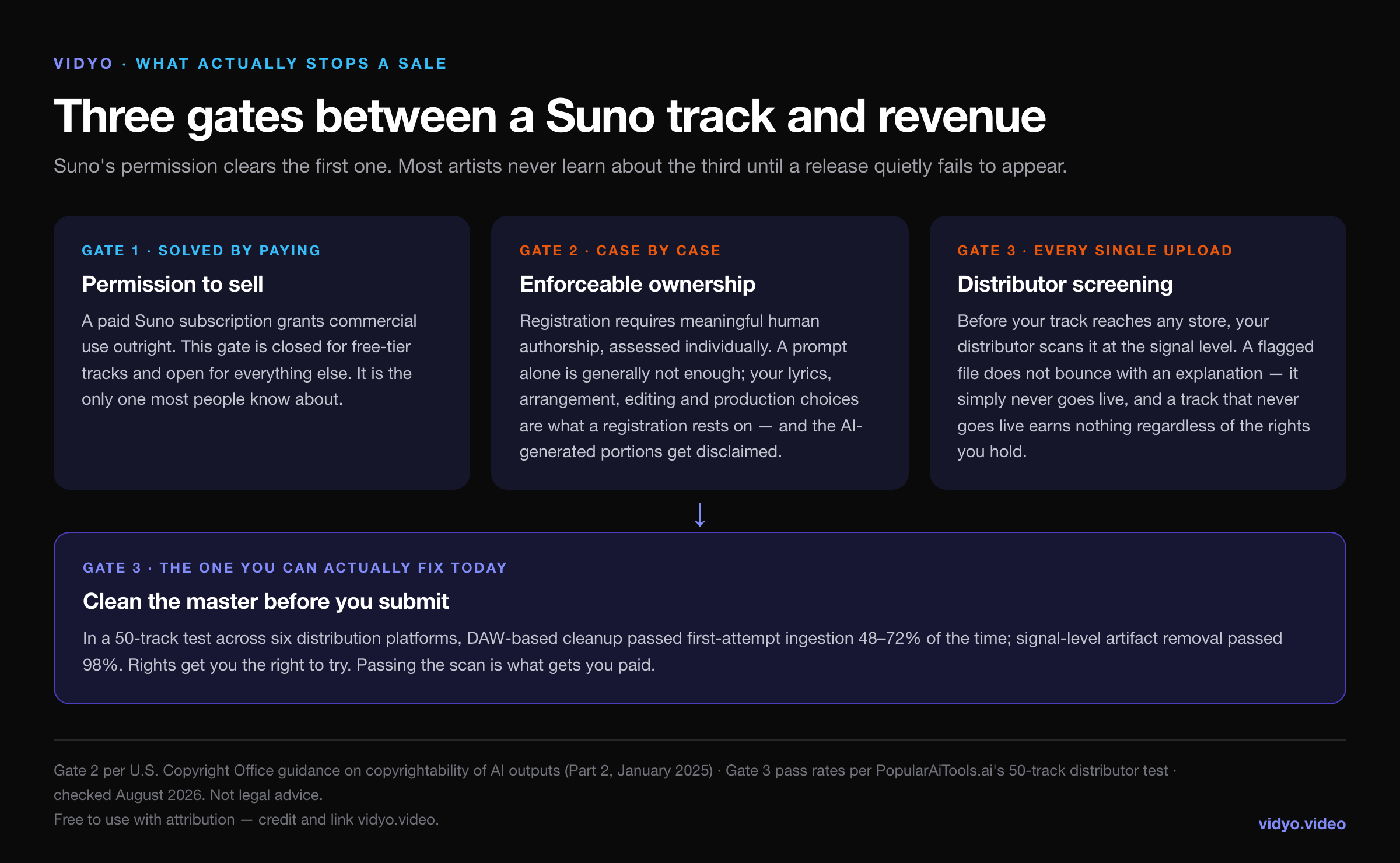
Before your track reaches a single store, your distributor screens it. That screening operates at the signal level, looking for the statistical fingerprints that mark audio as machine-generated — and it runs regardless of what rights you hold. Suno's licence is an agreement between you and Suno. It does not bind DistroKid, TuneCore or CD Baby, and it is not an argument you get to make to an automated ingestion pipeline.
The failure mode is what makes this expensive. A flagged track does not bounce back with an explanation of what to fix. In most cases it simply never goes live — and a track that never goes live earns nothing, no matter how clean your paperwork is. Artists routinely conclude their music just did not find an audience, when it never reached one.
This gate has also become materially harder recently. Suno announced in August 2026 that it is adopting tamper-resistant watermarking and fingerprinting, naming Audible Magic and Musixmatch as recognition partners — and Audible Magic already sits inside major distributor ingestion pipelines. We covered what that stack actually consists of in our breakdown of the Suno watermark.
Clearing the screening gate
The instinct is to reach for a DAW and clean the track up. The measured results say that instinct underperforms badly.
In a 50-track test run across six distribution platforms, measuring first-attempt ingestion: Ableton Live Suite, Logic Pro and FL Studio passed between 48% and 58% of the time, each demanding six to twelve hours of manual work per track. iZotope RX 11, a $399 forensic repair suite, reached 72%. Undetectr, which operates on the identifying signal rather than on audible quality, passed 98% — 49 of 50 accepted on first submission — at roughly ninety seconds per track. Our hands-on review rated it 4.75/5.
The reason for the gap is structural rather than a matter of tool quality. Ableton and Logic are superb at making audio sound better. Sounding better and reading differently to a scanner are unrelated properties — you can spend ten hours improving a mix and leave the fingerprint entirely intact.
Separately from all of the above, Suno starts metering downloads on September 3, 2026 — 7 lifetime on Free, 20/month on Pro, 60/month on Premier, applied retroactively to everything already in your library. Until that date, exporting costs nothing.
If you have a catalogue you have not pulled down yet, do it before the counter starts: undetectr.com/import-suno takes a public playlist to a single ZIP. Full detail in our download-limits breakdown.
How registration actually works
If you decide a track is worth registering, the mechanics are less mysterious than the debate around them suggests.
You file with your national copyright office as you would for any other work — in the US, through the Copyright Office's electronic system. The AI-specific part is a disclosure obligation: you identify the material that was AI-generated and disclaim it, then describe the human authorship you are claiming. The registration covers your contribution, not the disclaimed portions.
What examiners are assessing is whether your input rose above instruction-giving into genuine expressive choice. A useful way to think about it: could someone else, given only your prompt, have produced this exact result? If yes, the prompt is doing the work. If your lyrics, structural edits, comping decisions and mix shaped the outcome in ways a prompt could not specify, that is the authorship you are registering.
Practical consequences worth planning around:
- Lyrics can be registered separately. Words you wrote are literary work in their own right. This is the cleanest, least contestable claim available to most AI-assisted artists.
- Disclosure is not optional. Concealing AI-generated material in an application risks the registration itself. The Office has been explicit that applicants must identify it.
- Registration is not required to hold rights, but in the US it is generally required before you can sue, and timely registration affects the remedies available. That is the practical reason to bother.
Sync, YouTube and the places rights matter more
Streaming is where most people focus, but it is the context where the copyright gap matters least — you are being paid per play, not selling exclusivity. The gap bites hardest elsewhere.
Sync licensing. A production company licensing a track for an advert or a film is buying certainty. Contracts routinely ask you to warrant that you own the work and can indemnify them if that turns out to be untrue. Signing a warranty you cannot support is a materially worse problem than a rejected upload — read what you are being asked to promise, and say so if you cannot promise it.
Exclusive licences. Same principle, smaller scale. If a client is paying a premium for exclusivity, exclusivity is precisely the thing your rights may not extend to.
YouTube and Content ID. A separate system with separate rules, and one where AI-generated music has its own failure modes around claims and disclosure. We covered that ground in our piece on Content ID and AI music and in the YouTube disclosure requirements.
For ordinary streaming releases and Bandcamp sales, a paid Suno plan gives you what you need. It is when someone asks you to guarantee ownership that the distinction stops being academic.
What to do, practically
If you intend to sell what you make:
- Generate on a paid plan, always. Rights attach at creation. A free-tier track cannot be retroactively upgraded, and this is the cheapest mistake to avoid.
- Write your own lyrics. The single highest-leverage thing you can do for a copyright claim, and it costs nothing but effort.
- Keep records of your process. Prompts, iterations, edit decisions, arrangement choices. If you ever register, human contribution is what you will be asked to evidence.
- Do real post-production. It strengthens the authorship case and improves the record. It does not, on its own, get you past screening.
- Clean the master before submitting. The last step before your distributor, and the one that decides whether any of the rest mattered.
- Do not sell exclusivity you cannot back. If a client is paying for an exclusive licence, be careful about what you are promising — that is precisely where the copyright gap becomes real money.
The honest summary
Can you sell AI music made with Suno? On a paid plan, yes, unambiguously, and you keep 100% of the royalties. That part is settled and Suno documents it clearly.
Do you own it? Probably partially, depending on how much of yourself is genuinely in the track. Lyrics you wrote, arrangements you chose and production you performed are protectable. The purely generated audio underneath them is not, and no subscription tier changes that.
Will it reach a store? That is the question worth your attention, because it is the one with a fixable answer. Rights get you the right to try. Passing the scan is what gets you paid.
What the Suno watermark actually is · the September 3 download caps · our Undetectr review