Can You Upload AI Music to Spotify? What Actually Happens
Spotify allows AI-generated music and says all music is treated equally regardless of the tools used to make it. So why do AI tracks vanish? Because you never upload to Spotify — you upload to a distributor, and that's where the screening happens.
Contents9 sections
Yes. Spotify allows AI-generated music, and has said so about as plainly as a platform can: "Spotify does not create or own music; this is a platform for licensed music where royalties are paid based on listener engagement, and all music is treated equally, regardless of the tools used to make it."
Which raises the obvious question — if it is allowed, why do so many artists report that their AI track never appeared?
Because in nearly every case Spotify was never the obstacle. You do not upload to Spotify. There is no consumer upload form. Every track arrives through a distributor, and the distributor screens the file one step before Spotify's policy is ever consulted. Almost every "Spotify rejected my AI music" story is a distributor screening failure being blamed on the wrong party.
This article covers what Spotify's rules actually say, where the real gate sits, and the seven checks that decide whether a release goes live.
What Spotify's policy actually says
In September 2025 Spotify announced three measures in response to generative AI. The coverage read as a crackdown on AI music. Read directly, the policy is considerably narrower.
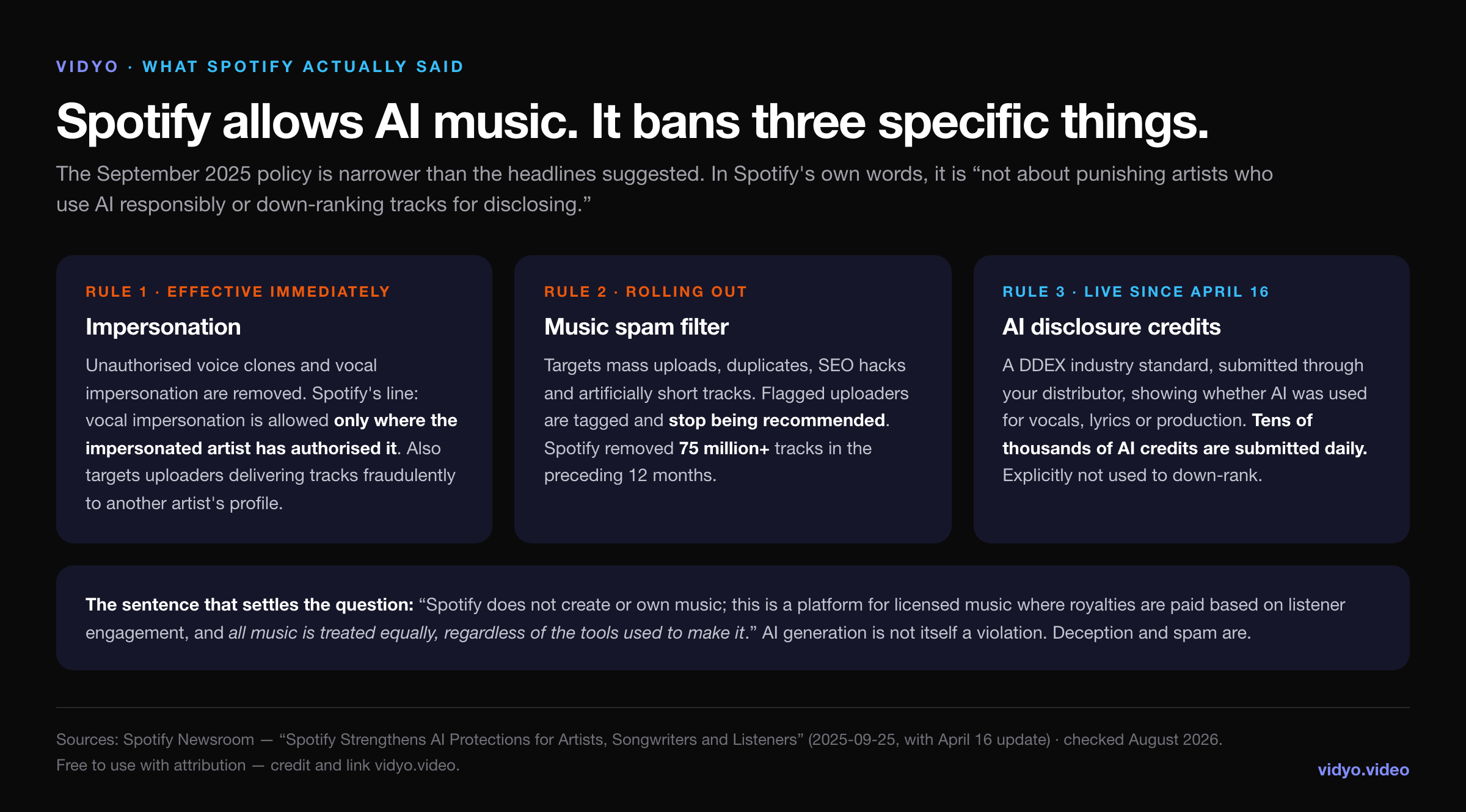
Impersonation. Unauthorised voice clones and vocal impersonation are removed. Spotify's position is that vocal impersonation is permitted only where the impersonated artist authorised it — some artists do license their voices, and Spotify's stated aim is keeping that choice in their hands. It also covers uploaders fraudulently delivering tracks to someone else's artist profile.
The spam filter. Aimed at mass uploads, duplicates, SEO hacks and artificially short tracks. Flagged uploaders get tagged and stop being recommended. For scale: Spotify removed over 75 million tracks in the twelve months before the announcement, and total payouts grew from $1B in 2014 to $10B in 2024 — the payout pool is what attracts the spam.
AI disclosure credits. A DDEX industry standard letting you declare whether AI contributed vocals, lyrics or production, submitted via your distributor. It went into beta on April 16 and Spotify reports tens of thousands of AI credits submitted daily. Crucially, Spotify states this is "not about punishing artists who use AI responsibly or down-ranking tracks for disclosing information about how they were made."
Read together: generating with AI is not a violation. Deceiving people and spamming the catalogue are. Those are different things, and the distinction is the whole policy.
The gate that actually stops you
Here is the structural detail that reframes the entire question.
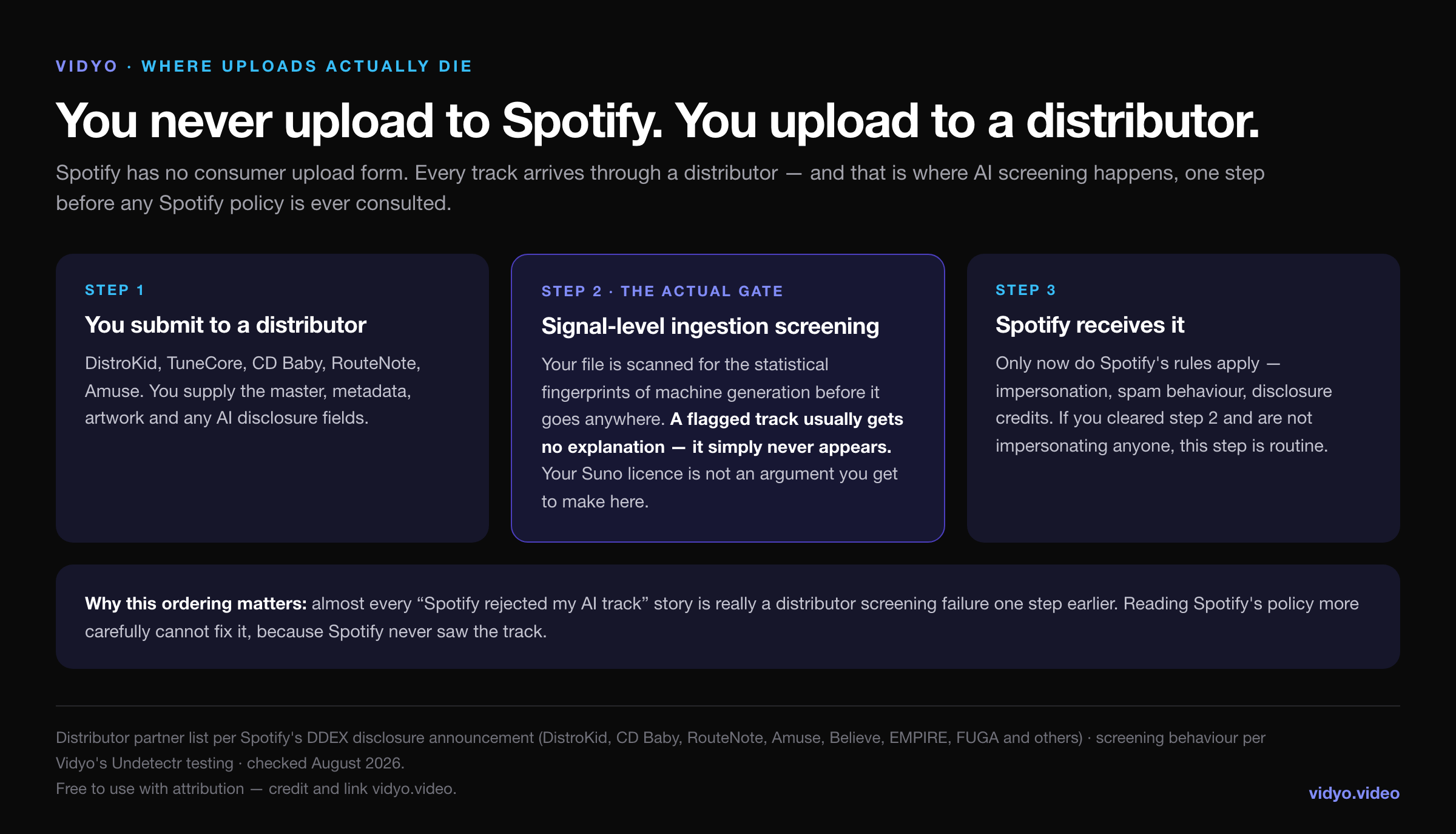
Your track goes to DistroKid, TuneCore, CD Baby, RouteNote or Amuse. Before it is delivered anywhere, it passes through ingestion screening that scans at the signal level for the statistical fingerprints of machine generation — phase relationships, sub-threshold noise patterns, vocoder artifacts.
Two things make this gate expensive. First, it runs regardless of your rights: a Suno commercial licence is an agreement between you and Suno, and it is not an argument you can put to an automated pipeline. Second, the failure is silent. A flagged track generally does not come back with an explanation of what to fix — it simply never appears. Artists conclude the music did not find an audience, when it never reached one.
This screening has also tightened recently. Suno announced in August 2026 that it is adopting tamper-resistant watermarking and fingerprinting, naming Audible Magic and Musixmatch as recognition partners — and Audible Magic already sits inside major distributor ingestion pipelines. We broke down what that stack consists of in our piece on the Suno watermark.
Seven checks before you submit
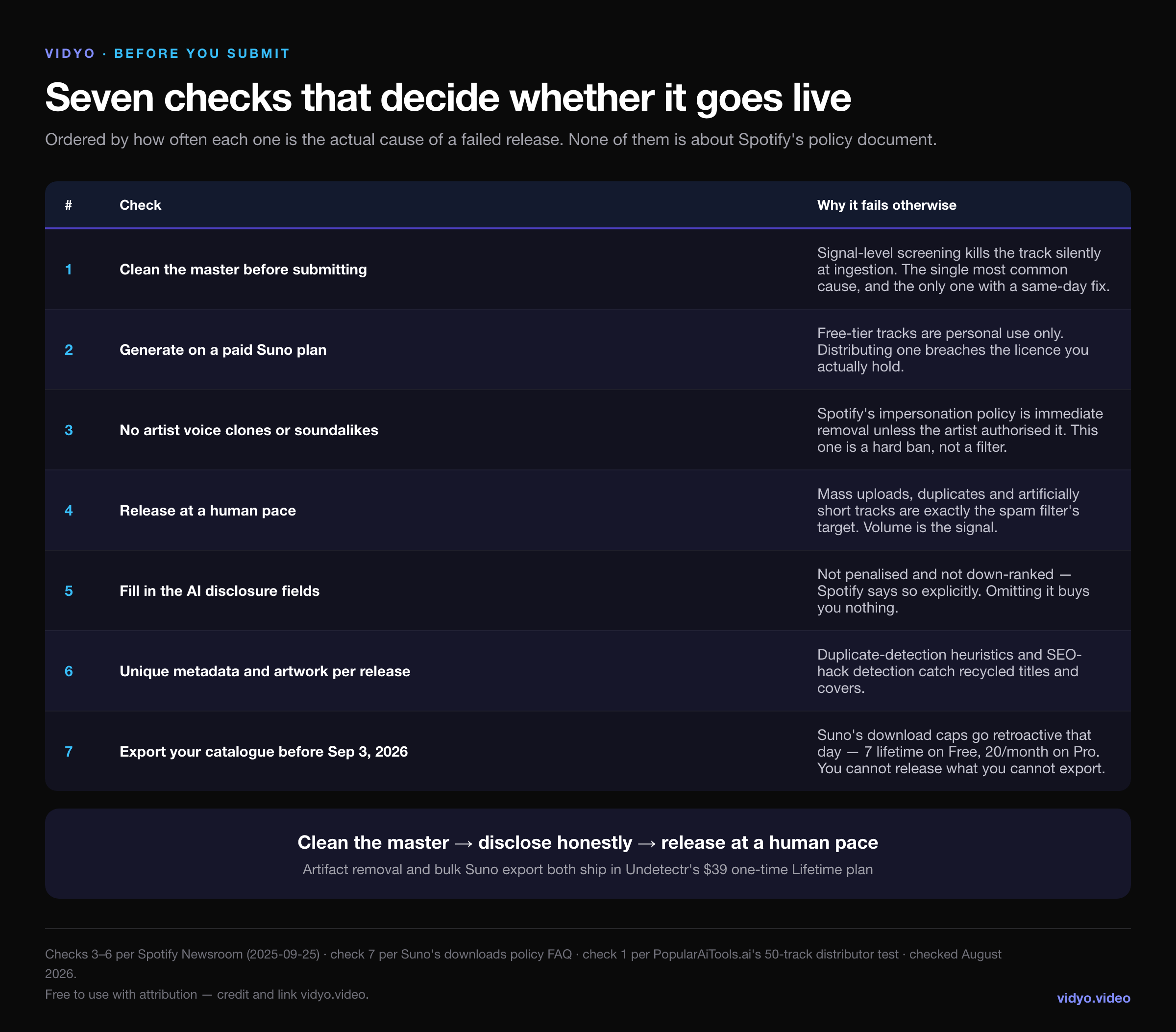
Working through them in order:
- Clean the master first. The most common cause of a silent failure and the only one with a same-day fix. More on the numbers below.
- Generate on a paid Suno plan. Free-tier tracks are personal, non-commercial use only — distributing one breaches the licence you actually hold. Rights attach at creation, so upgrading later does not retroactively cover old generations. Full detail in our guide to Suno's commercial rights.
- No voice clones or deliberate soundalikes. This is a hard ban with immediate removal, not a ranking penalty. It is also the one rule here that can cost you your distributor account.
- Release at a human pace. Mass uploads and duplicates are precisely what the spam filter looks for. Twelve considered singles a year reads very differently from two hundred.
- Fill in the AI disclosure fields. Spotify says explicitly it does not down-rank for disclosing. Withholding it gains you nothing and costs you credibility if it surfaces another way.
- Unique metadata and artwork per release. Recycled titles and covers trip duplicate-detection and SEO-hack heuristics.
- Export your Suno catalogue before September 3, 2026. Download caps go retroactive that day — 7 lifetime on Free, 20/month on Pro, 60/month on Premier. You cannot release what you cannot export.
What clearing the screening actually takes
The intuitive move is to open a DAW and clean the track up. The measured results say that intuition is expensive.
In a 50-track test across six distribution platforms, scored on first-attempt ingestion: Ableton Live Suite passed 58%, Logic Pro 54% and FL Studio 48%, each requiring six to twelve hours of manual work per track. iZotope RX 11, a $399 forensic repair suite, reached 72%. Undetectr, which processes the identifying signal rather than the audible qualities, passed 98% — 49 of 50 accepted first time — in roughly ninety seconds per track. Our hands-on review scored it 4.75/5.
The gap is structural, not a knock on the DAWs. Ableton and Logic are built to make audio sound better. Sounding better and reading differently to a scanner are unrelated properties — you can spend a full day improving a mix and leave the fingerprint completely intact.
The bulk Suno export you need before September 3 and the artifact removal you need before every submission are both included in Undetectr's $39 one-time Lifetime plan — unlimited playlist downloads, unlimited processing, MP3/WAV/FLAC output. One payment, not a subscription.
Why the screening got strict
It helps to understand what the platforms are actually reacting to, because it explains why the enforcement is aimed where it is.
The volume numbers are genuinely extraordinary. Deezer has reported receiving roughly 90,000 fully AI-generated tracks per day — more than half of everything uploaded to it, a figure that grew ninefold in eighteen months. Spotify removed over 75 million tracks for spam and fraud in a single twelve-month window.
But here is the number that reframes it: by Deezer's own estimate, AI tracks account for only about 1–3% of actual listening, while up to 70% of the streams they do receive are fraudulent. That gap is the entire story. The flood is not listeners discovering AI music — it is bot-driven royalty farming, uploading enormous catalogues and streaming them artificially to skim the payout pool.
Two consequences follow for a legitimate artist. First, the enforcement is aimed at volume and fraud patterns, not at AI as a creative tool — which is exactly what Spotify's policy wording reflects. Second, you are collateral damage in a fight you are not part of, and the way out is to look nothing like the thing being targeted: modest release cadence, real metadata, honest disclosure, and a master that clears screening on its own merits.
Does the distributor you pick matter?
Somewhat, though less than the forums suggest, and not in the direction people assume.
There is no distributor that waves AI music through. Screening is broadly comparable across the majors because they are all protecting the same relationship with the same stores — a distributor that floods Spotify with flagged content risks its own delivery pipeline. Choosing based on rumours about who is "easier" is chasing a difference that mostly does not exist, and the rumours go stale fast.
What does differ, and is worth weighing:
- Whether AI disclosure fields are available yet. Spotify names DistroKid, CD Baby, RouteNote, Amuse, Believe, EMPIRE, FUGA and others among its DDEX disclosure partners. Spotify has also noted that not all distributors support disclosure yet, so this varies.
- Pricing model against your release cadence. Flat annual fees favour frequent releases; per-release pricing favours occasional ones. This is the choice that actually affects your finances.
- How they handle a rejection. The useful question to ask support before committing: if a track fails ingestion, do you get told why? Some are far more forthcoming than others, and that is worth more than a small price difference.
The uncomfortable but accurate summary: the file you submit matters considerably more than who you submit it through.
Apple Music, YouTube Music and the rest
Because they share the distribution layer, most of this transfers directly. You submit once and your distributor delivers everywhere, so a track that clears ingestion generally reaches Apple Music, Amazon Music, Tidal, Deezer and YouTube Music together. A track that fails ingestion reaches none of them — which is why artists sometimes report a release vanishing from every service at once and assume a coordinated ban.
Two places the rules genuinely diverge. Deezer has been the most aggressive on labelling, tagging AI-generated tracks and excluding them from algorithmic recommendations and chart calculations — allowed, but visibly marked. And YouTube is a different system entirely: uploads go direct rather than through a distributor, Content ID operates on its own logic, and there are separate disclosure requirements for synthetic content. We covered that in the YouTube AI disclosure rules and Content ID for AI music.
Will it actually earn anything?
Worth separating from the mechanics, because "allowed on Spotify" and "makes money on Spotify" are different claims.
Spotify pays on listener engagement and treats all music equally regardless of tools. So an AI-assisted track earns exactly what an equivalent human-made track earns at the same play count. There is no AI penalty rate.
What there is, is the same brutal distribution curve every independent artist faces. Getting a track live is the beginning of the work, not the end of it. AI removes the production bottleneck; it does nothing about the attention bottleneck, and the flood of AI-generated uploads has made attention harder to come by rather than easier. If your plan is volume, note that volume is the exact behaviour the spam filter was built to catch.
The honest summary
Can you upload AI music to Spotify? Yes. It is permitted, it is not down-ranked for being AI-assisted, and there is now a formal way to disclose it that carries no penalty.
The three things that will actually stop you are impersonating an artist, behaving like a spam farm, and — far more often than either — failing distributor screening one step before Spotify ever sees the file. The first two are choices. The third is a technical problem with a technical fix, and it is the one worth solving before your next release rather than after it.
Suno's commercial rights explained · what the watermark actually is · the September 3 export deadline