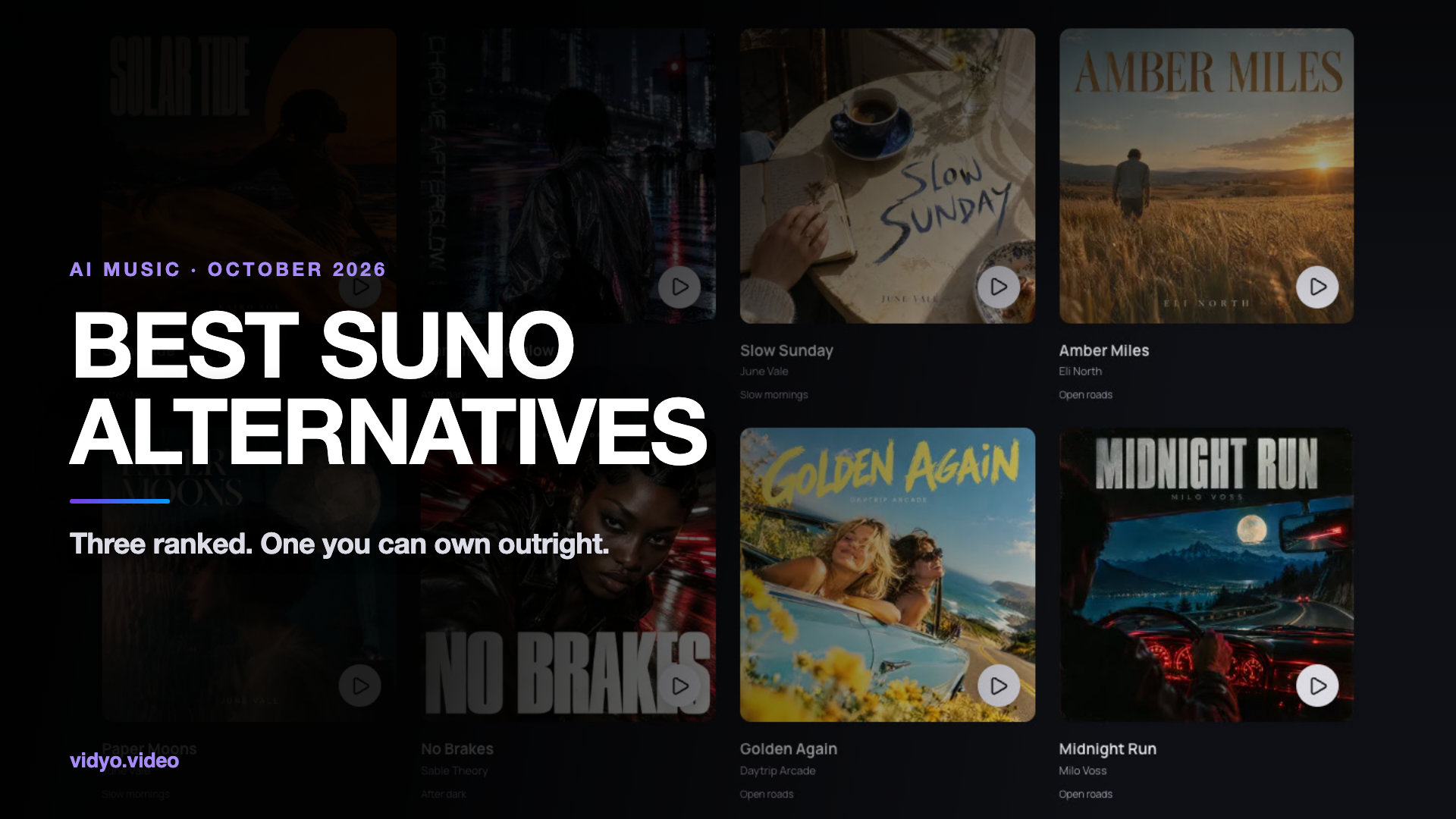
Best Suno Alternatives 2026: 3 Ranked, Only One Worth It
We ranked three Suno alternatives on downloads, ownership, price and sound, and went through every WaveQuake example. WaveQuake wins; Mureka and Udio fall short.
Contents10 sections
- The ranking at a glance
- How we ranked them
- Why people are looking for a Suno alternative
- 1. WaveQuake: the best Suno alternative
- We went through every WaveQuake example
- 2. Mureka: a busy studio with costly terms
- 3. Udio: you can't take the song with you
- Which Suno alternative should you pick?
- How to switch from Suno to WaveQuake
- Related reading
Most "best Suno alternative" lists are the same ten logos with the same three sentences under each. This one has three entries, and only one of them gets a recommendation. We ranked WaveQuake, Mureka and Udio on the things that decide whether an AI song can actually carry a release or a music video: can you download it, do you own it, what does it cost, and what evidence is there that it sounds good.
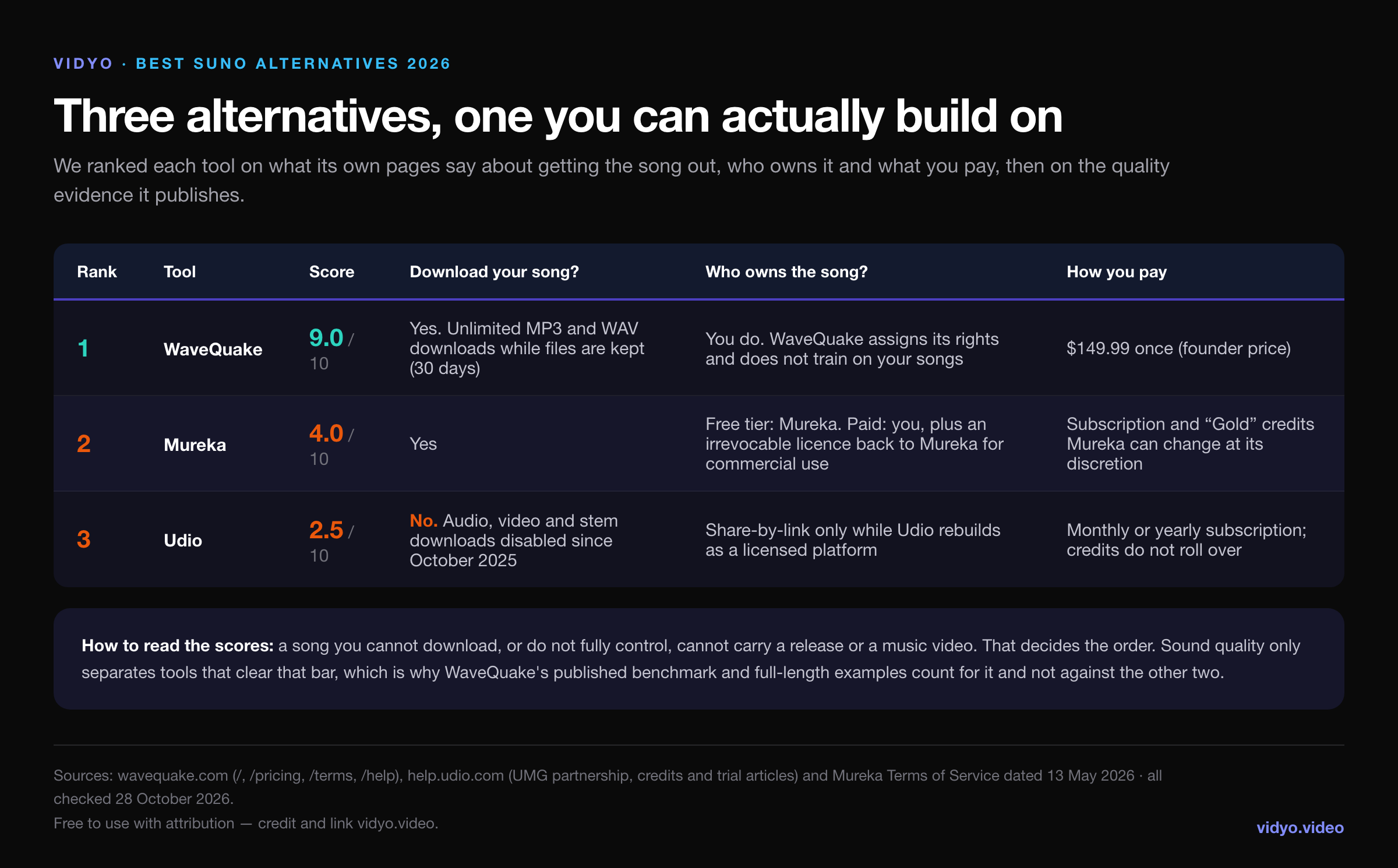
WaveQuake wins clearly, at 9.0 out of 10. Mureka scores 4.0 because its terms take an irrevocable licence to everything you make. Udio scores 2.5 because, as of today, you cannot download anything you make on it. Every product claim below comes from each company's own pages, read on 28 October 2026, and we went through all twelve of the example songs on WaveQuake's site, measuring each one and transcribing its lyrics.
The ranking at a glance
| Rank | Tool | Score | Best for | The deal-breaker |
|---|---|---|---|---|
| 1 | WaveQuake | 9.0 / 10 | Vocal songs you want to release, sell or cut a video to | None. Download what you want inside 30 days, and know that purchases are final |
| 2 | Mureka | 4.0 / 10 | Playing with ideas on a free daily allowance | Free songs belong to Mureka; paid songs come with an irrevocable licence back to Mureka |
| 3 | Udio | 2.5 / 10 | Listening and sharing links inside Udio | Audio, video and stem downloads have been switched off since October 2025 |
How we ranked them
Sound quality is the first thing people ask about, and it is the last thing that matters if you cannot use the file. So we judged in this order:
- Can you get the song out? A track that only plays inside the generator's website cannot go to a distributor, a video editor or a client.
- Who owns it, and what does the company keep? We read the output and licence clauses of each tool's terms, not the marketing copy.
- What does it cost, and can the price move under you? Subscriptions, credits and one-time prices are not equal when the company can change the rules.
- What evidence is there for quality? Published benchmarks and full-length examples count. Adjectives on a homepage do not.
For WaveQuake we also downloaded all eight original examples and all four cover examples from its listening room, measured loudness and true peak with ffmpeg's EBU R128 meter, and ran every track through Whisper large-v3-turbo on our own machine to check whether the lyrics come through clearly. The results are in the examples section.
Why people are looking for a Suno alternative
Suno rewrote its terms on 10 August 2026, effective 3 September. Five changes matter to anyone who releases a song or builds a video around one, and all five are in Suno's own words on its terms of service and its download FAQ, both re-read on 28 October 2026.
| What changed on Suno | Suno's own wording | Why it matters |
|---|---|---|
| Download caps | "Free: Up to 7 total (lifetime) trial downloads"; "Pro: 20 downloads per month"; "Premier: 60 downloads per month" | Every take you audition against a video edit is a download |
| Caps cover old songs | "including songs created before that date" | Your back catalogue is now rationed too |
| No rollover | "unused downloads don't carry over" | A quiet month does not bank downloads for a busy one |
| Commercial use needs a permitted download | "You may not commercially exploit Output that has not been downloaded by you through an approved channel" | No download, no release and no monetised video |
| No retroactive licence | subscribing later "will not give you a retroactive license" | A free-plan song cannot be upgraded into a release |
Two more clauses push people toward the exit. Remixes made through Suno's features are joint works "owned jointly and equally", limited to personal, non-commercial use on every tier. And everything you put in or get out, plus any Voice Model, sits under a perpetual, irrevocable licence that Suno can use to improve its models. On price, Suno Premier billed yearly comes to $864 over three years. Those are the problems each alternative below is measured against.
1. WaveQuake: the best Suno alternative (9.0 / 10)
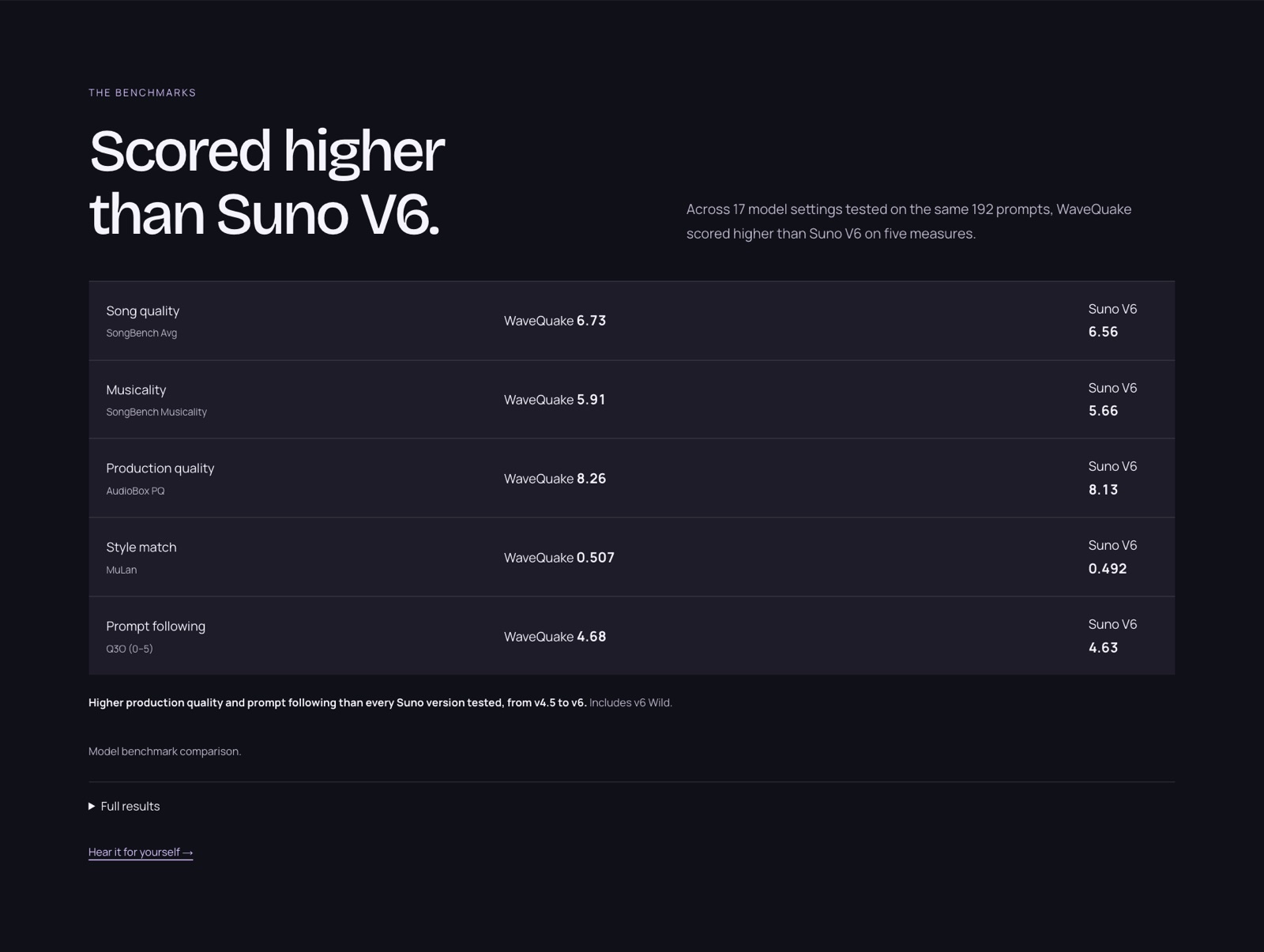
WaveQuake is a browser music studio that writes lyrics, generates two versions of each song, makes covers from recordings you have permission to use, and masters the take you choose. It is sold as a one-time purchase: $149.99 once at the founder price, which WaveQuake says will rise to $499.99 after the founder offer. For comparison, Suno Premier is $288 a year billed yearly.
That $149.99 buys 3,000 creation minutes with no separate song-count limit, two versions per successful generation (only the longer one counts against your minutes), 2,000 writing requests for its Songwriter and Soundprint tools, mastering, and a full commercial licence. There is no subscription and nothing renews. Optional top-ups add minutes when you run out. Our full WaveQuake review walks through each tool.
The quality evidence
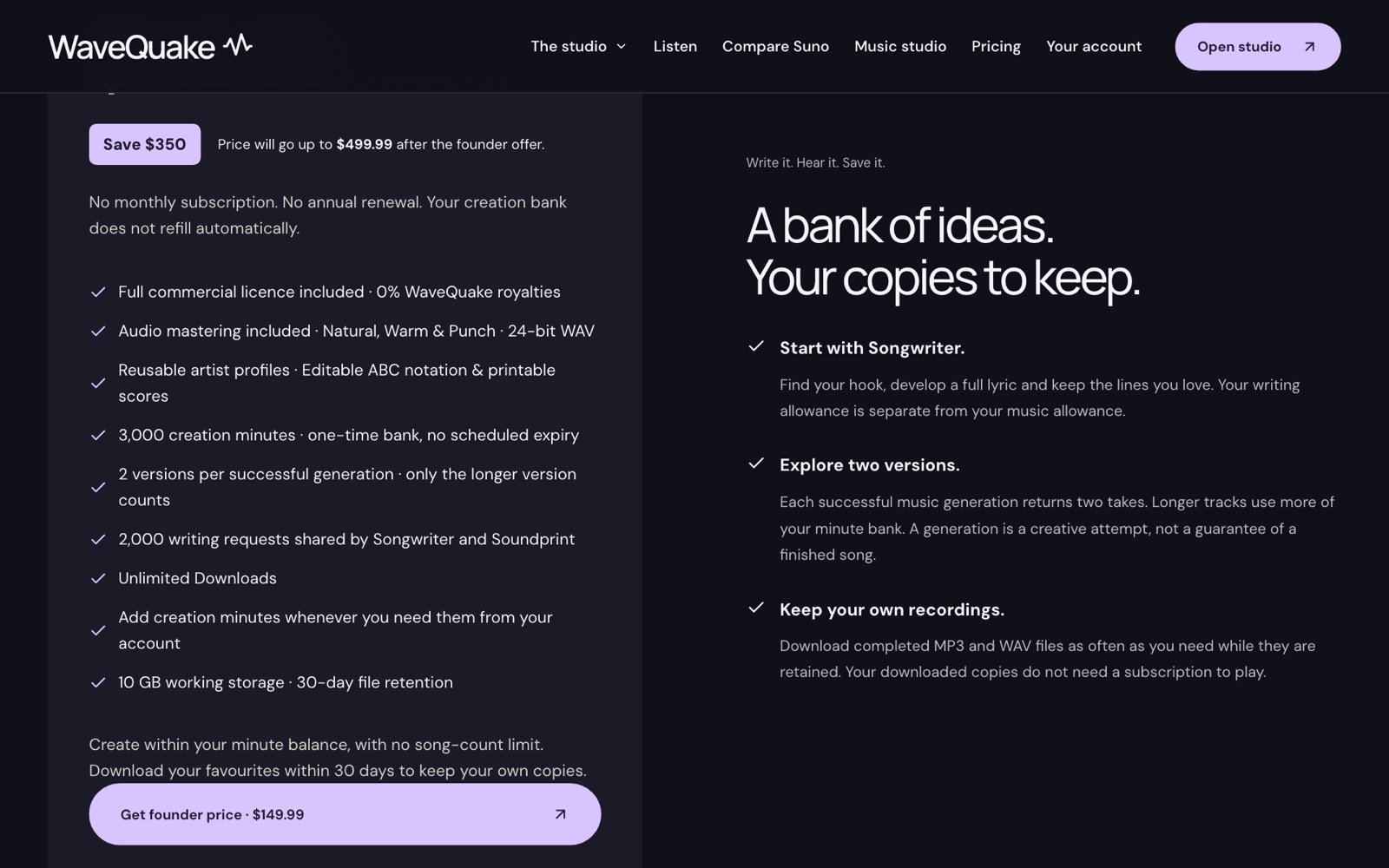
WaveQuake publishes a model benchmark comparison against Suno V6 on the same 192 prompts. On the headline measure, overall song quality (the SongBench average), its model scores 6.73 against Suno V6's 6.56. It also leads on the four measures below, and WaveQuake says its model beat every Suno version tested, from v4.5 to v6, on production quality and prompt following.
| Measure | WaveQuake | Suno V6 |
|---|---|---|
| Song quality (SongBench average) | 6.73 | 6.56 |
| Musicality (SongBench) | 5.91 | 5.66 |
| Production quality (AudioBox PQ) | 8.26 | 8.13 |
| Style match (MuLan) | 0.507 | 0.492 |
| Prompt following (Q3O, 0 to 5) | 4.68 | 4.63 |
Read the full panel and you will see Suno V6 edges ahead on four of the nine measures: SongEval average (4.31 to 4.26), SongEval musicality (4.26 to 4.22), caption match (0.430 to 0.405) and lyric error rate (0.0758 to 0.0844, lower is better). WaveQuake publishes those too, which we count in its favour, along with its own caveat that the model's research team ran these tests and they "are not human preference scores". Take the benchmark as a reason to listen, then listen.
Ownership and downloads: where it pulls away
This is the section that separates WaveQuake from the other two. Its terms say that, as between you and WaveQuake, "you own the rights in your Outputs to the extent those rights exist", and that "We assign to you any rights in those Outputs that we hold". The only permission you give back is a narrow one to store and process files so the service works, and the terms state it "does not authorise us to advertise with your identity or Content, sell your Content as a dataset or use it to train generative models".
Downloads are defined just as plainly: "downloading your available completed files as often as you wish, with no download credits, numerical download allowance or per-download charge". Both versions of every song come down as MP3 or WAV, and downloading never spends creation minutes. The terms also do not force you into arbitration or waive class-action rights, and they promise at least 60 days' notice plus a refund of unused prepaid value if the service ever closes.
What to watch before you buy
- Files are kept for 30 days. Unlimited downloads apply while files are retained, so download the takes you want the day you make them.
- All sales are final under terms version 1.3, apart from refunds the law requires and the closure remedies in the terms.
- It makes vocal songs only. WaveQuake's help page says the browser music service "needs lyrics and vocals, and chooses the song length automatically". If you need a 30-second instrumental cut to an exact frame count, edit it yourself.
- The founder price is temporary. WaveQuake says the price goes to $499.99 after the founder offer.
We went through every WaveQuake example
WaveQuake's listening room has eight original songs and four covers, all full length. These are vendor-picked, so treat them as the best the model does rather than an average result. Here is what we found when we measured and transcribed every one.
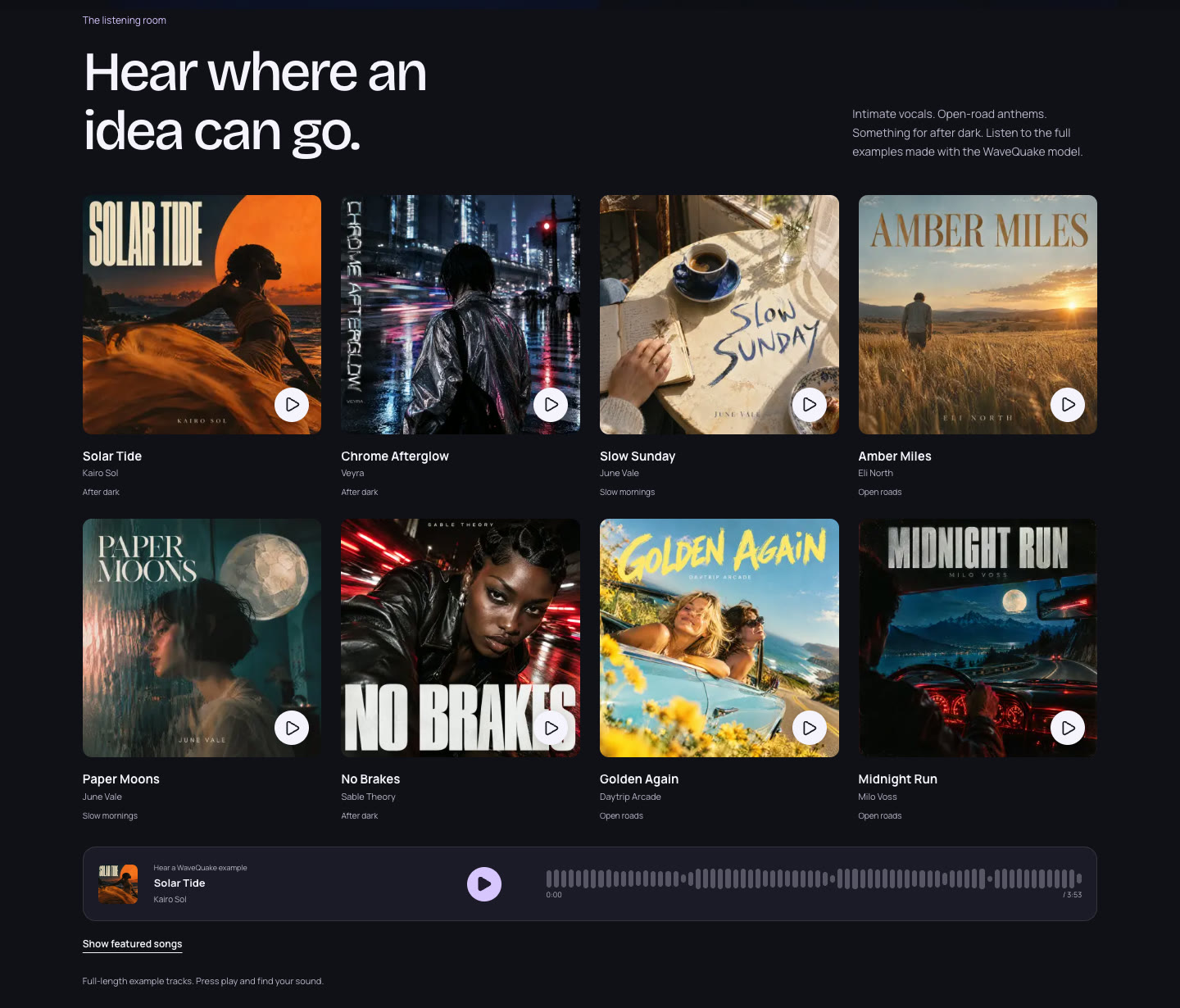
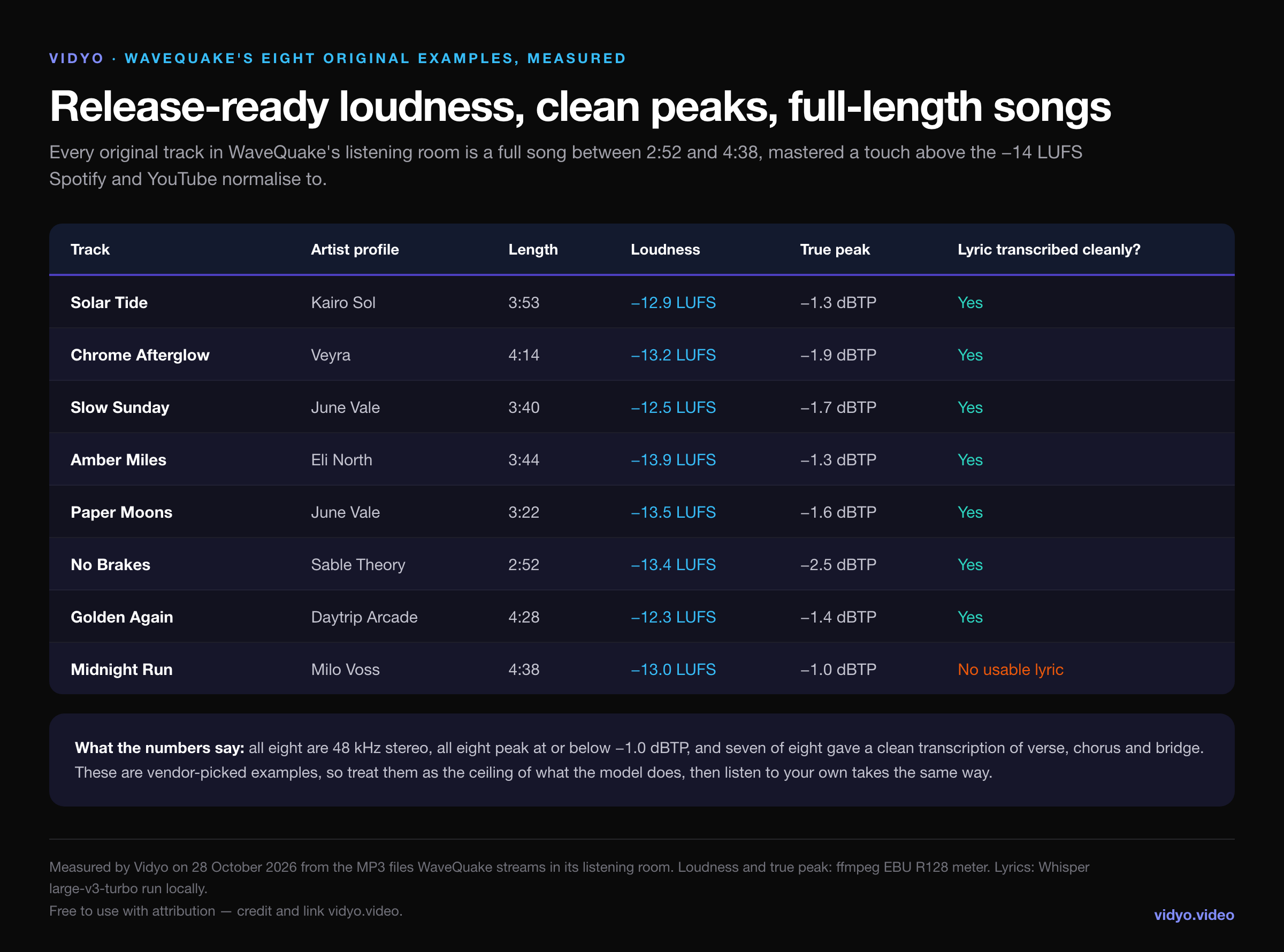
The pattern is consistent. Seven of the eight read on the transcript as complete songs with verses, a chorus and a bridge, not one-minute loops. Integrated loudness sits between −12.3 and −13.9 LUFS, a touch above the −14 LUFS that Spotify and YouTube normalise to, so platforms will turn these down slightly rather than up. Every original peaks at or below −1.0 dBTP. Seven of eight produced a clean, readable transcription, which is a decent proxy for clear vocal diction.
Solar Tide by Kairo Sol
After dark · 3:53
The lyric is a short film about waiting for a reply: a phone face down on the table, three dots that appear and freeze, and a hook that begs "Red dot, red dot, don't make me wait". It holds the steadiest level in the set, with a loudness range of just 2.3 LU, and one of the two most centred mixes. That constant energy suits a performance video, and the lyric practically writes the shot list for you.
Chrome Afterglow by Veyra
After dark · 4:14
The verses are built from small domestic details (bills, a sink, a shoe by the door) and the chorus lands on a plain refrain: "This is life", then "Hold on tight". Repeated hooks like that are natural cut points, so this is the easiest of the eight to edit a montage against. It sits at −13.2 LUFS with peaks at −1.9 dBTP, comfortably inside streaming limits.
Slow Sunday by June Vale
Slow mornings · 3:40
It opens on its hook, "Coffee on your lip", and the chorus pays it off with "Coffee on your lip, coffee in my head". A bridge drops to "Let the kettle hiss / Let the rain tap glass" before the last chorus. Opening on the hook matters for short-form: the intro already works as a teaser. At −12.5 LUFS it is one of the louder masters here.
Amber Miles by Eli North
Open roads · 3:44
The most traditionally written song of the eight. The lyric is pure Americana (a split-rail fence, a county line, a yellow truck with a stuck tailgate) and it follows a textbook verse, pre-chorus, chorus, bridge shape around "Wheat fields, wheat fields, keep me here". Every line transcribed cleanly, which tells you the diction is clear. It is the quietest master in the set at −13.9 LUFS.
Paper Moons by June Vale
Slow mornings · 3:22
This is the second song credited to the June Vale profile, so play it straight after Slow Sunday to judge how consistent a saved artist sounds across tracks. The hook is "Paper skin, paper skin", and it has the widest loudness range in the set at 6.8 LU, so it has more light and shade than the other seven. For an intimate, performance-led video, that dynamic shape is what you want.
No Brakes by Sable Theory
After dark · 2:52
The shortest and most driving example, built around a chanted "Run it, run it, run it back again" and a repeated "Hold on tight" tag. It has the most headroom of any original (true peak −2.5 dBTP), one of the tightest loudness ranges at 2.5 LU and a centred mix. Under three minutes and steady from start to finish, it is the obvious pick for fast cutting and vertical edits.
Golden Again by Daytrip Arcade
Open roads · 4:28
A day-in-the-life song that moves from sunrise to a midday phone call to a song on the radio, all circling "Happy, sad, then happy again" and "That's just how the hours behave". It is the loudest master in the set at −12.3 LUFS. The timeline in the lyric gives a director an obvious structure: shoot one day, morning to night.
Midnight Run by Milo Voss
Open roads · 4:38
The weak spot. Our transcription pass returned no usable lyric from this one, so the vocal is either sitting well back in the mix or not delivering clear words. It is also the longest track and the hottest original at −1.0 dBTP, right on the ceiling Spotify recommends. Use it as a driving bed under picture rather than a lyric-led edit, and listen for yourself before you decide.
The four cover examples
WaveQuake's cover tool takes a recording you have permission to process and returns two new versions in a different voice and arrangement. All four transcribed cleanly, and three of the four have comfortable headroom.
| Cover | Credited to | Length | Loudness | True peak |
|---|---|---|---|---|
| Jingle Bells | The Winter Arcade | 3:48 | −12.9 LUFS | +0.2 dBTP |
| Rocking Around The Christmas Tree | Ruby & The Midnight Stars | 2:32 | −14.3 LUFS | −1.5 dBTP |
| Santa Baby | Cleo Winters | 3:43 | −14.0 LUFS | −2.7 dBTP |
| Golden | HUNTR/X · Cover version | 3:36 | −13.9 LUFS | −2.0 dBTP |
One flag: the Jingle Bells preview peaks at +0.2 dBTP, the only file of the twelve above full scale, which can clip on some playback chains. Run your own covers through WaveQuake's mastering, which promises "checked peaks", before release. And remember that a cover of someone else's song still needs the songwriter's licence before you put it out. Jingle Bells is in the public domain; the other three are not.
2. Mureka: a busy studio with costly terms (4.0 / 10)
Mureka is run by Skywork AI Pte. Ltd. in Singapore. Open it and you get a lot of buttons: a V9.5 model selector, Agent, Custom and Soundtrack modes, Reference, Remix and Vocal inputs, a Create Video tool and a Studio. You can try it on a small free daily allowance. On features alone, it looks like a serious Suno alternative.
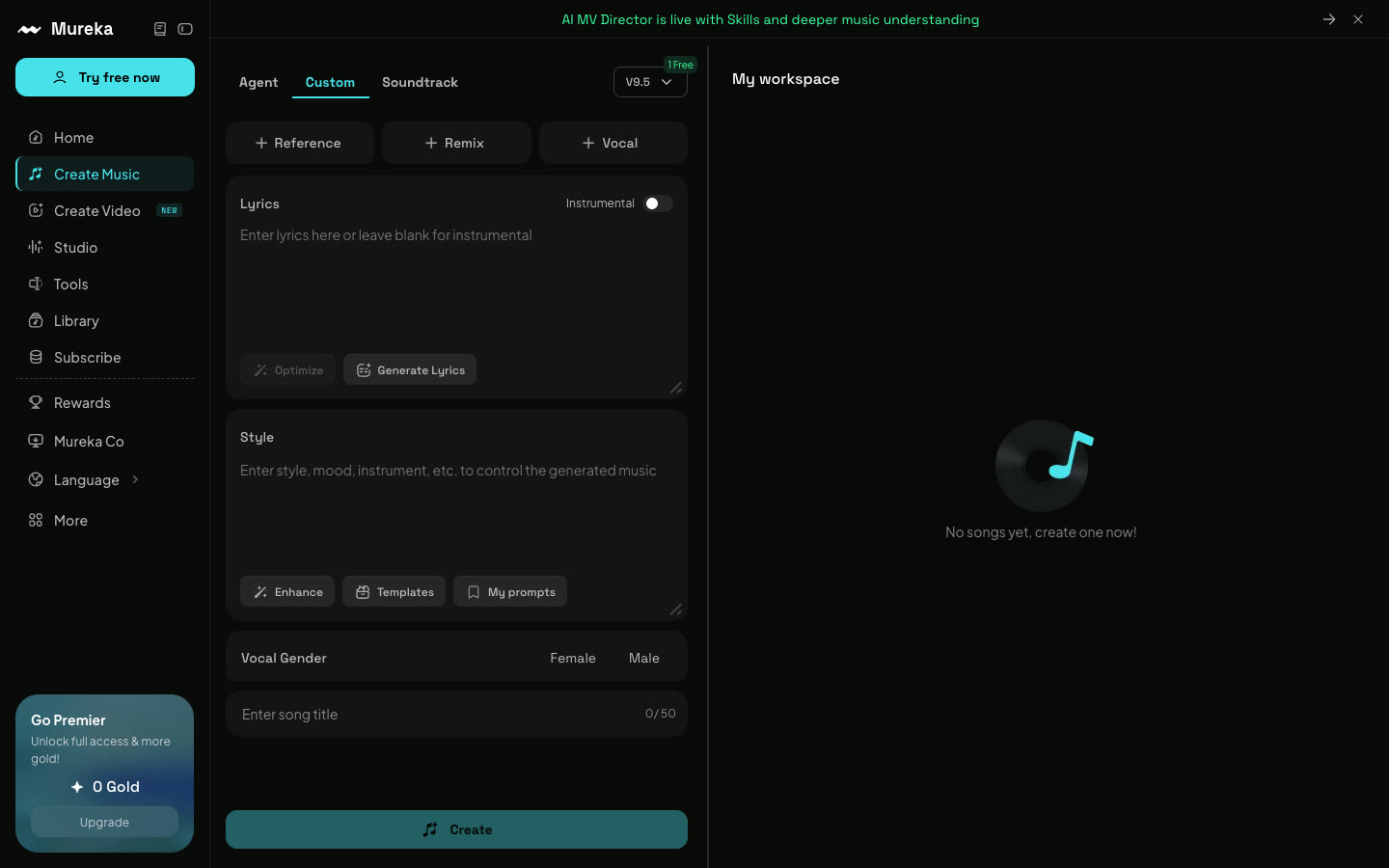
The problems are in its Terms of Service, dated 13 May 2026.
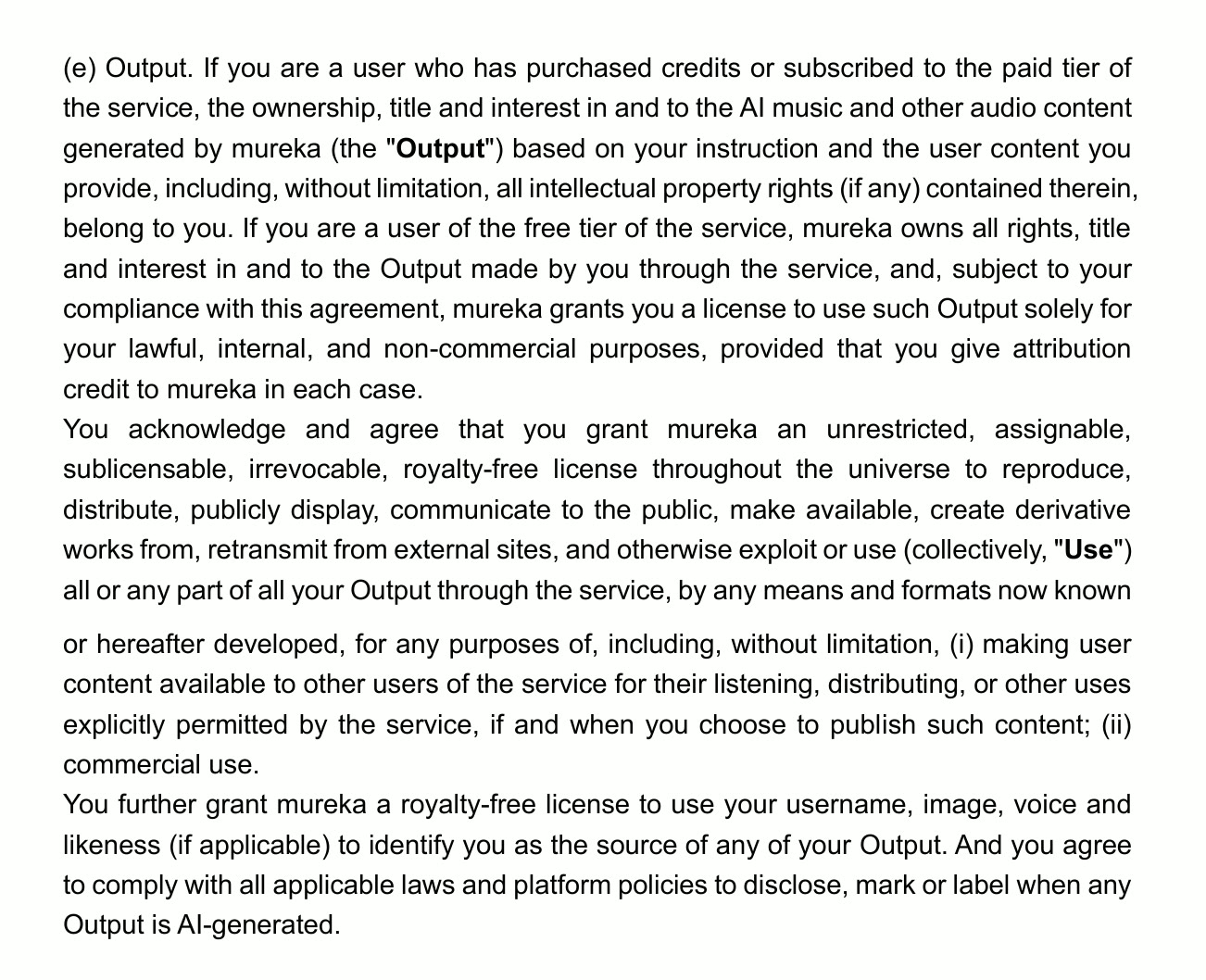
- Free-tier songs are not yours. On the free tier, "mureka owns all rights, title and interest in and to the Output made by you". You get a licence only for "lawful, internal, and non-commercial purposes", and you must "give attribution credit to mureka in each case". No monetised video, no release.
- Paid songs come with a licence back to Mureka. Paying makes the output yours, but you also grant Mureka "an unrestricted, assignable, sublicensable, irrevocable, royalty-free license throughout the universe" to reproduce, distribute and make derivative works from all of your output, for purposes including "commercial use". You own the song; Mureka can use it commercially anyway, forever.
- Your name goes with it. You also grant Mureka a royalty-free licence to use "your username, image, voice and likeness" to identify you as the source of your output.
- Credits are Mureka's to change. Mureka reserves "the absolute right to reduce, manage, regulate, control, modify and/or eliminate the Credits as it sees fit", consumption "may vary" with task complexity, and you get nothing back for unused credits when an account closes.
- Disputes go to Singapore. Claims go to arbitration at the Singapore International Arbitration Centre before three arbitrators, individually only, with no class actions. Subscription refunds go through Apple, Google or Stripe.
3. Udio: you can't take the song with you (2.5 / 10)
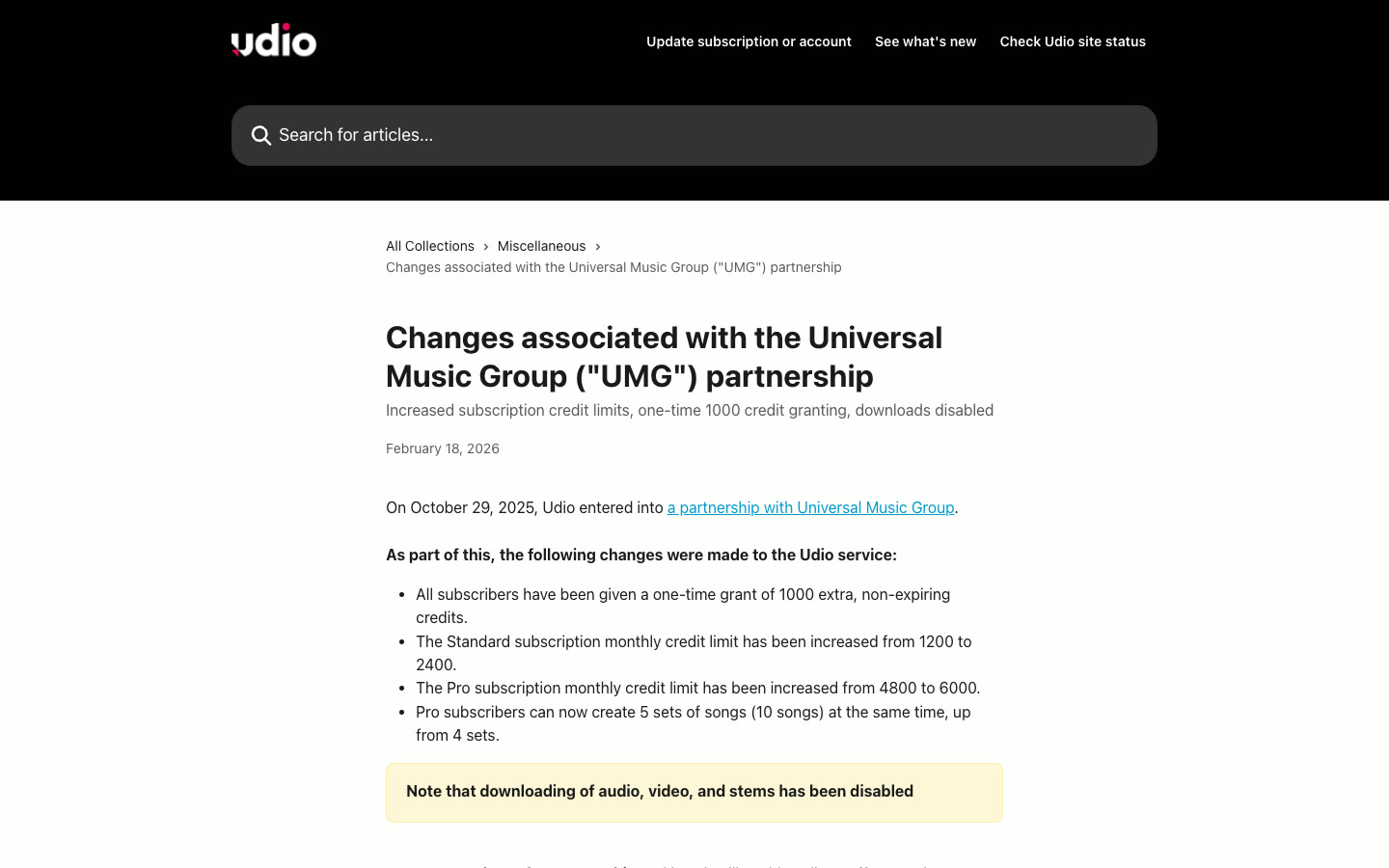
For a long stretch Udio was the usual answer to "what is the alternative to Suno?". That changed on 29 October 2025, when Udio entered a partnership with Universal Music Group. Udio's own help article on the change lists extra credits for subscribers, then this line: "Note that downloading of audio, video, and stems has been disabled".
Warner Music Group followed in November 2025. Udio's WMG article says the service runs under a "transition ToS" while it builds a licensed platform, and that during the transition you can "keep sharing your Udio songs with others through udio.com URLs". A link is all you get. You cannot put a udio.com link on Spotify, under a YouTube video or into an editing timeline.
The rest of the picture does not help:
- Older models. The same article lists the v1, v1.5 and v1.5 Allegro models for the transition, and Udio's changelog shows Allegro v1.5 arriving in March 2025.
- Songs come in pieces. Per Udio's credits article, each generation makes two songs of either 32 or 130 seconds, longer tracks have to be built up with Extend, and free accounts can make only three 130-second songs a day. Credits do not roll over on any plan.
- The trial bills a year. Udio's trial article says that if you do not cancel within seven days you are "immediately charged the full price of an annual subscription" unless you switched to monthly first. Its own example is $96 plus tax.
- No date for the fix. Udio's help centre gives no launch date for the licensed platform or for downloads returning.
Which Suno alternative should you pick?
- You want to release, sell or cut a video to your songs: WaveQuake. You own the output, downloads are unlimited, the licence takes no royalty and you pay once.
- You only want to experiment for free: Mureka's free tier will let you play, but read the terms. Those songs belong to Mureka and cannot be used commercially.
- You need the file: skip Udio until its download ban lifts.
- You are staying on Suno for now: our guide to Suno download limits shows how to spend your monthly downloads on the songs you will actually release.
How to switch from Suno to WaveQuake
- Rescue your Suno catalogue first. Download the Suno songs you plan to use while you still have a paid plan, because commercial use on Suno depends on a permitted download.
- Start from the words. Write or paste lyrics in WaveQuake's Songwriter, or use Soundprint to turn an artist reference into a sound direction.
- Generate, then compare both versions. Each generation gives you two takes. Play both all the way through, the way we did with the examples above.
- Master the keeper. Pick Natural, Warm or Punch and download the separate 24-bit WAV.
- Download within 30 days. Keep your own copies of the MP3, the WAV and the lyrics.
Staying on Suno for a while longer? Our guide to Suno download limits covers how to spend the downloads you have left, and selling Suno music covers what each kind of Suno song can legally do.